
Live Racing Markets: Finding Edges After the Off
I remember the exact moment I understood in-play betting on horse racing. It was a two-mile hurdle at Newbury, and the odds-on favourite stumbled at the second flight. Didn’t fall, just pecked on landing and lost three lengths. Within seconds, the in-play price on the exchange shot from 1.5 to 3.0. The horse recovered, led at the last, and won by four lengths. Anyone who backed it in-play at 3.0 doubled their effective odds on a horse that was never in genuine danger. The market had panicked, and the panickers paid.
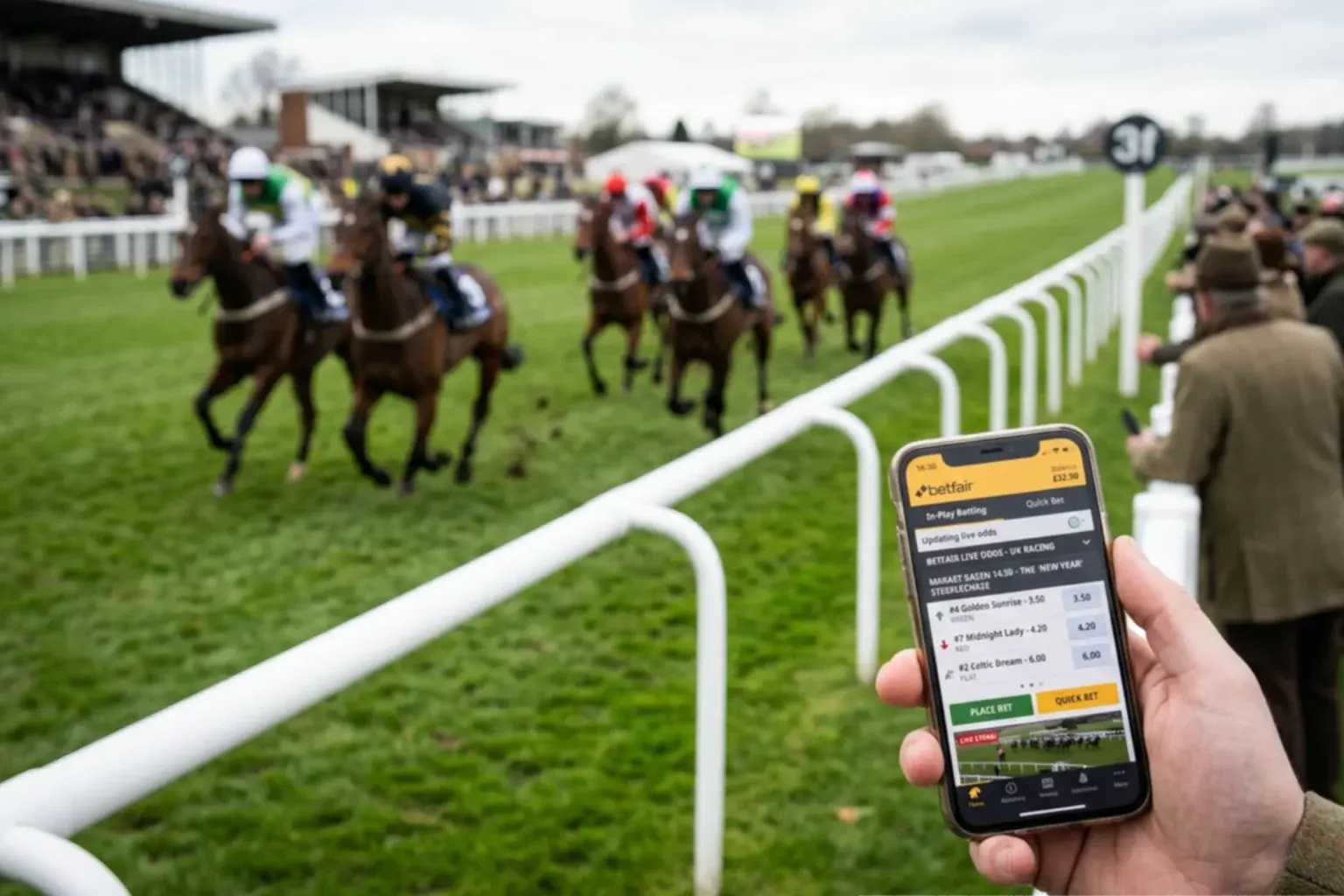
In-play betting on horse racing is the most technically demanding form of punting. The entire window — from when the stalls open or the tape goes up until the horse crosses the line — lasts between 55 seconds (a five-furlong sprint) and eight minutes (a four-mile chase). Within that window, prices fluctuate continuously, information is incomplete, and decisions must be made in seconds rather than hours. UK operators have invested around 150 million dollars annually in platform technology, and a significant portion of that investment targets in-play infrastructure: faster data feeds, smoother price updates, and lower latency between the track and your screen.
The question isn’t whether in-play betting is exciting — it is. The question is whether it’s profitable, and the answer depends entirely on whether you have a structural edge in processing live information faster or more accurately than the market.
How In-Play Markets Work on Exchanges and Fixed-Odds Platforms
Exchange in-play markets and fixed-odds in-play markets operate on fundamentally different principles, and choosing the wrong one for your purpose costs money.
On an exchange, in-play prices are set by other punters in real time. When a horse jumps badly, backers exit their positions (laying to close) and new layers emerge at shorter prices, creating the kind of rapid price movement I witnessed at Newbury. Exchange in-play markets are the purest expression of live information — prices move because people with different interpretations of what’s happening on the track are trading against each other. Liquidity is thinner in-play than pre-race, which means large bets can move the price, but for stakes under 100 pounds, execution is usually immediate.
Fixed-odds in-play markets from traditional bookmakers work differently. The operator sets the price using algorithms that process live positional data, and they suspend the market during critical moments — a fall, a stewards’ inquiry, or any event that would give bettors an informational advantage over the pricing model. The advantage of fixed-odds in-play is simplicity: you see a price, you click, you get it (subject to acceptance). The disadvantage is that the operator’s margin is wider in-play than pre-race, typically 20-30%, because they’re pricing in the risk of offering odds on a rapidly evolving event.
The total number of licensed betting shops in the UK fell to 5,825 by March 2025, a 36% decline over ten years. That shift from retail to digital has accelerated in-play betting volumes, because the technology simply doesn’t exist in a betting shop — you can’t bet in-play at a counter with the same speed and precision that a mobile app provides. The migration to mobile is essentially a migration to in-play capability, and it’s reshaping how the market functions.
The Information Edge: What You Can See That the Algorithm Cannot
In-play betting algorithms process positional data — which horse is leading, by how far, at what point in the race. They don’t process visual information with the same nuance as an experienced race reader. This gap is where human in-play bettors have their only reliable edge.
A horse that’s travelling strongly in fourth, ears pricked, jockey motionless, is in a fundamentally different position from a horse that’s also in fourth but being niggled along, responding sluggishly, and looking like it’s at the end of its effort. The algorithm sees “fourth, three lengths behind the leader.” The experienced race watcher sees “full of running, poised to strike” versus “cooked, about to fade.” That visual assessment, made in real time, is the basis for profitable in-play decisions.
Jump racing offers more in-play opportunities than flat racing because races are longer, more things can change (mistakes at fences, variations in jumping style), and the visual information is richer. A horse that fiddles its way through the first three fences but then starts to pop them cleanly is improving during the race in a way the algorithm can’t easily capture. Backing that horse in-play, after you’ve seen it settle into a rhythm, carries genuine informational value.
Flat racing in-play is harder because the races are shorter and the positional data is more deterministic. In a five-furlong sprint, a horse that’s fifth at halfway is almost certainly going to finish out of the first two. The in-play prices reflect this with brutal efficiency, and there’s very little room for human assessment to outperform the algorithm. I restrict my flat in-play activity to races of a mile or beyond, where the tactical dimension creates enough uncertainty to generate exploitable price movements.
When In-Play Betting Works and When It Costs You
The scenarios where in-play betting is justifiable are narrower than most punters realise. Having watched hundreds of races with in-play markets running, I’ve identified three specific situations where the live market regularly misprices.
First: the false scare. A well-fancied horse makes a jumping mistake, stumbles on landing, or drops back a couple of positions. The in-play price lurches outward. If the horse is genuinely unhurt and has simply lost momentum — not balance — the longer price represents a window of opportunity. The key judgment is whether the mistake was a genuine setback (the horse is now uncomfortable or has lost confidence) or merely a speed bump. Experience watching racing is irreplaceable here.
Second: the pace collapse. A strongly run race suddenly slows because the leaders have gone too fast and begin to fade. Hold-up horses, sitting 10 lengths off the pace, are suddenly closer without having done any extra work. Their in-play prices shorten, but often not enough — the market prices their positional improvement without fully accounting for the fact that they’ve conserved energy while the front-runners have spent theirs. In stayers’ races (two miles-plus on the flat, three miles-plus over jumps), pace collapses are common and predictable if you watch the early sectional times.
Third: the trading exit. If you backed a horse pre-race and it’s travelled well into contention with two furlongs to run, you can lay it in-play at a shorter price to lock in profit. This isn’t really “in-play betting” in the analytical sense — it’s risk management. But it’s the most consistently profitable use of in-play markets because it removes the outcome risk from a bet that’s already moved in your favour. The cash-out function achieves something similar through a fixed-odds operator, but the exchange in-play lay gives you more control over the price and the timing.
The Stream Delay Problem and Why It Matters
Every live stream you watch through a betting app or website runs on a delay. That delay — typically 2-5 seconds on most platforms, sometimes longer — means the prices you see on screen have already been adjusted for events you haven’t seen yet. When a horse falls at a fence, the exchange price reacts before your stream shows the fall. You see the price spike, wonder what happened, and by the time you see the horse on the ground, the price has already settled at its new level.
This latency disadvantage is structural. Professional in-play traders use satellite data feeds with minimal delay, sometimes under one second, and they price markets based on information that reaches them two to four seconds before your stream shows it. Betting against these participants on speed alone is a losing proposition — they will always have the positional data before you do.
The workaround is to trade on interpretation, not information. You can’t beat the data feed on timing, but you can beat it on judgment. The feed tells the algorithm that Horse A is third, three lengths behind the leader, with four fences to jump. Your eyes tell you that Horse A is travelling better than anything else in the race, its jockey hasn’t moved, and the two horses ahead of it are being ridden hard. That interpretive layer — the quality of the position, not just the position itself — is slower to update than raw data, and it’s where human in-play bettors retain their edge.
The practical implication: never make an in-play bet based purely on price movement. If the price suddenly shortens and you don’t know why, don’t jump on it — by the time you see what happened on your delayed stream, the price will have moved past the point of value. Only bet in-play when your visual assessment of the race provides the reason, and the price movement confirms rather than drives your decision.
Building an In-Play Discipline
The single most important in-play rule is this: set a budget before the race starts and stick to it. In-play betting is uniquely vulnerable to emotional escalation because the race is happening right in front of you, every second brings new information, and the urge to act is powerful. Without a pre-set limit, a single race can consume a week’s betting budget in three minutes of impulsive clicking.
I allocate a maximum of 10% of any day’s betting activity to in-play. If my daily budget is 50 pounds, no more than 5 pounds goes into in-play positions across the entire card. That constraint forces selectivity — I can’t bet in-play on every race, so I choose the one or two races where I have the strongest visual read and the best chance of identifying a mispriced movement.
Record-keeping for in-play bets is critical and harder than for pre-race bets because the decisions happen faster and the reasoning is more instinctive. I note the in-play price, my reasoning at the time, what I saw that triggered the bet, and the outcome. Reviewing these records after a month reveals whether my in-play instincts are calibrated or whether I’m paying for the excitement of live action without the returns to justify it. Most punters who honestly audit their in-play results discover they’d be better off restricting themselves to pre-race betting. That’s not a failure — it’s useful information about where their genuine edge lies.