

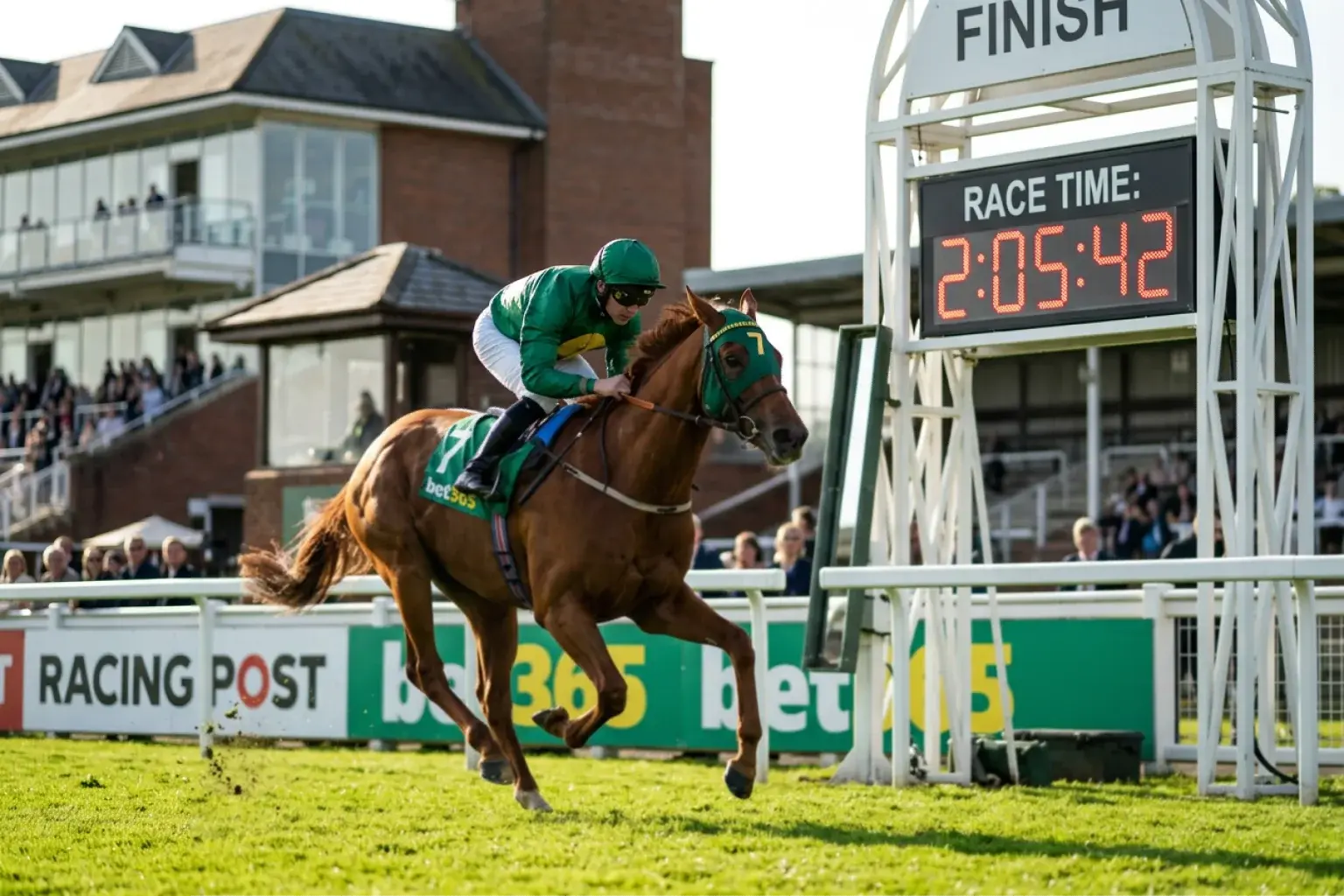
Speed Figures Analysis: Using The Clock for Higher Payouts
I spent years reading form the traditional way — race position, beaten distances, class of race, jockey bookings. It worked, up to a point. Then I started looking at speed figures and realised I’d been ignoring a dimension of performance that the clock captures and the eye misses. A horse that wins a Class 4 handicap by a length in a fast time has done something measurably different from one that wins the same race by five lengths in a slow time, even though the second horse “looked” more impressive.
Speed figures assign a numerical rating to each performance based on the time the horse ran, adjusted for the day’s going, the wind conditions, and a standard time for the course and distance. The result is a number that can be compared across different courses, different days, and different ground conditions. Think of it as translating every performance into a common language — stripping out the noise of circumstance and leaving the signal of pure ability.
In a UK market where roughly 48% of adults participate in some form of gambling, horse racing’s appeal rests partly on this kind of analytical depth. Speed figures aren’t a magic bullet — no single metric is — but they’re the closest thing flat racing has to an objective measure of what a horse actually did, as opposed to what it looked like doing.
How Speed Figures Are Calculated
The core calculation starts with the race time and works backward through layers of adjustment. The raw time is compared to a standard time for the course and distance — a benchmark derived from historical data representing the expected time for an average horse on good ground with no wind. The difference between the actual time and the standard time produces a raw speed rating.
That raw number is then adjusted for the going. On soft ground, every furlong takes fractionally longer, and the adjustment factor scales with the severity of the going. A horse that runs two seconds slower than standard on heavy ground hasn’t necessarily run a bad race — the going adjustment might reveal it actually ran to a figure higher than a horse that ran one second faster on good ground. This is the transformative step: it lets you compare performances that happened in completely different conditions.
Wind adjustment is more controversial and varies between figure compilers. A strong headwind in the straight slows times; a tailwind speeds them up. Some figure producers estimate wind impact using weather station data. Others ignore it on the grounds that wind affects all runners equally (which isn’t entirely true — runners at the front break the wind for those behind). My preference is to use figures that include a wind adjustment, even an imperfect one, because the alternative is pretending wind doesn’t exist.
The final adjustment accounts for sectional times where available. A horse that ran the first half of the race slowly and the second half fast produced a different physical effort from one that ran an even pace throughout, even if the overall times are identical. Sectional-adjusted figures capture this difference and are particularly useful for identifying horses with untapped potential — specifically, those that were held up in slowly run races and produced a fast finish that the overall time doesn’t reflect.
Speed Figures vs Official Ratings: What Each One Captures
The BHA’s official rating and a speed figure measure different things, and confusing them leads to bad analysis. The official rating is the handicapper’s expert judgment of a horse’s ability, incorporating race position, beaten distances, quality of opposition, visual impression, and sectional data. It’s a subjective assessment — informed and professional, but ultimately an opinion about what the horse is capable of.
A speed figure is a measurement of what the horse actually did. It doesn’t care about the quality of opposition, the visual impression, or the jockey’s ride. It cares about how fast the horse covered the distance relative to the conditions. A horse might receive a cautious official rating because it won a weak race by a short head, but its speed figure might be high because the overall time was fast despite the narrow winning margin. The official rating says “this horse might be limited.” The speed figure says “this horse ran fast.”
The most productive use of both metrics is to look for discrepancies between them. A horse whose best speed figure is significantly higher than its official rating is potentially underrated by the handicapper. These horses are carrying less weight than their raw ability justifies, which creates the same mathematical edge as a well-handicapped horse identified through traditional form analysis — but through a completely different lens.
The reverse discrepancy is useful too. A horse whose official rating is higher than any speed figure it’s produced might be rated on visual impression or competitive performance in strong races rather than on raw speed. These horses are potentially overrated — they look better than they are in time terms, and they’ll struggle when the pace demands genuine speed rather than tactical effectiveness.
Practical Application: When Speed Figures Help Most
Speed figures are most useful in sprint and mile races on the flat, where the race is run at a genuine pace throughout and the time reflects genuine effort. Over five furlongs to a mile, there’s less tactical variation and the clock captures a higher proportion of the horse’s true ability. Over longer distances, the race shape becomes more complex — horses can be held up, the pace can collapse in the middle, and the overall time becomes a less reliable indicator of individual ability.
They’re also most useful on flat, galloping tracks where the course geometry doesn’t introduce variables the time can’t capture. Newmarket, Doncaster, York, and Ascot on the round course all produce reliable speed figures because the tracks are fair, well-maintained, and relatively uncomplicated. Tight tracks like Chester, Epsom, or Brighton produce less reliable figures because the time is influenced by factors (bend sharpness, camber, undulations) that the standard adjustment doesn’t fully account for.
For jump racing, speed figures are useful but less decisive. Chase and hurdle times are affected by jumping style, obstacle negotiation, and fallers disrupting the pace in ways that don’t translate cleanly into an adjusted time figure. I use jump speed figures as a secondary filter rather than a primary tool — a confirming data point when the form analysis already suggests a selection, not a standalone reason to back a horse. The strategy toolkit for jumps relies more heavily on form analysis and ground assessment than on time-based metrics.
Where to Find Speed Figures and How to Read Them
Several providers publish speed figures for UK racing. The Racing Post’s Racing Post Rating (RPR) is the most widely available, appearing on every racecard and in the form book. Timeform’s ratings combine speed-figure analysis with visual assessment and are available through subscription. Independent figure compilers such as Proform and Raceform produce their own variants, each with slightly different adjustment methodologies.
The scale varies between providers, but the principle is consistent: higher numbers mean faster performances. A typical Racing Post speed figure might range from 50 (weak Class 6 performance) to 130 (elite Group 1 standard). The key isn’t the absolute number — it’s the comparison between horses in the same race. If Horse A’s best figure is 95 and Horse B’s best figure is 87, Horse A has demonstrably run faster when conditions are normalised. Whether that eight-point gap translates to a four-length advantage or a three-length advantage depends on the distance, but the direction is clear.
Consistency of figures matters as much as peak figures. A horse whose last five speed figures are 92, 90, 93, 91, 94 is a far more reliable betting proposition than one whose figures read 101, 78, 96, 72, 105. The first horse consistently runs to a level that’s identifiable and bankable. The second horse is unpredictable — capable of brilliance and mediocrity in equal measure. I weight consistency heavily in sprint handicaps, where the field sizes are large enough that one erratic run is unlikely to land in the right place by coincidence.
Improvement in figures over a sequence of runs is the most valuable pattern of all. A horse whose figures read 80, 84, 87, 89 across its last four starts is improving at a rate that the handicapper may not have fully captured in the official rating. That upward trajectory, visible in the speed figures, is the quantitative evidence for a horse that’s “going the right way” — a phrase form readers use instinctively but rarely back up with data.