
Racing Bet Variations: Choosing Wagers for Maximum Payout
A friend once asked me to explain what a Lucky 15 was. Twenty minutes and three napkin diagrams later, she looked at me and said, “So it’s fifteen bets with four horses?” That’s exactly right, and the fact that something so simple in concept sounds so complicated in explanation is why most punters stick to win singles and never explore what else is available.
Each-way bets saw a 25% increase at Cheltenham 2024 alone, confirming that UK racing punters are willing to use more complex bet structures when the situation warrants it. The problem isn’t appetite — it’s clarity. Most bookmaker help sections explain bet types with wall-of-text definitions that read like legal disclaimers. This guide takes the opposite approach: every bet type explained through what it does, when it makes sense, and when it’s a waste of your money.
I’ve used every bet type listed here across nine years of serious racing. Some of them I use weekly. Some I’ve touched once and never will again. The distinctions matter, because choosing the wrong bet type can turn a perfectly good selection into a mathematically poor wager.
Single Bets: Win, Place, and Each-Way
The win single is the foundation of everything. You back a horse to win, and if it does, you’re paid at the agreed odds. If it doesn’t, you lose your stake. No complications, no secondary conditions, no hidden mechanics. For roughly 82% of Grand National bettors who stake five pounds or less, a win single is the default — and for most regular punters, it should be the core of their betting activity.
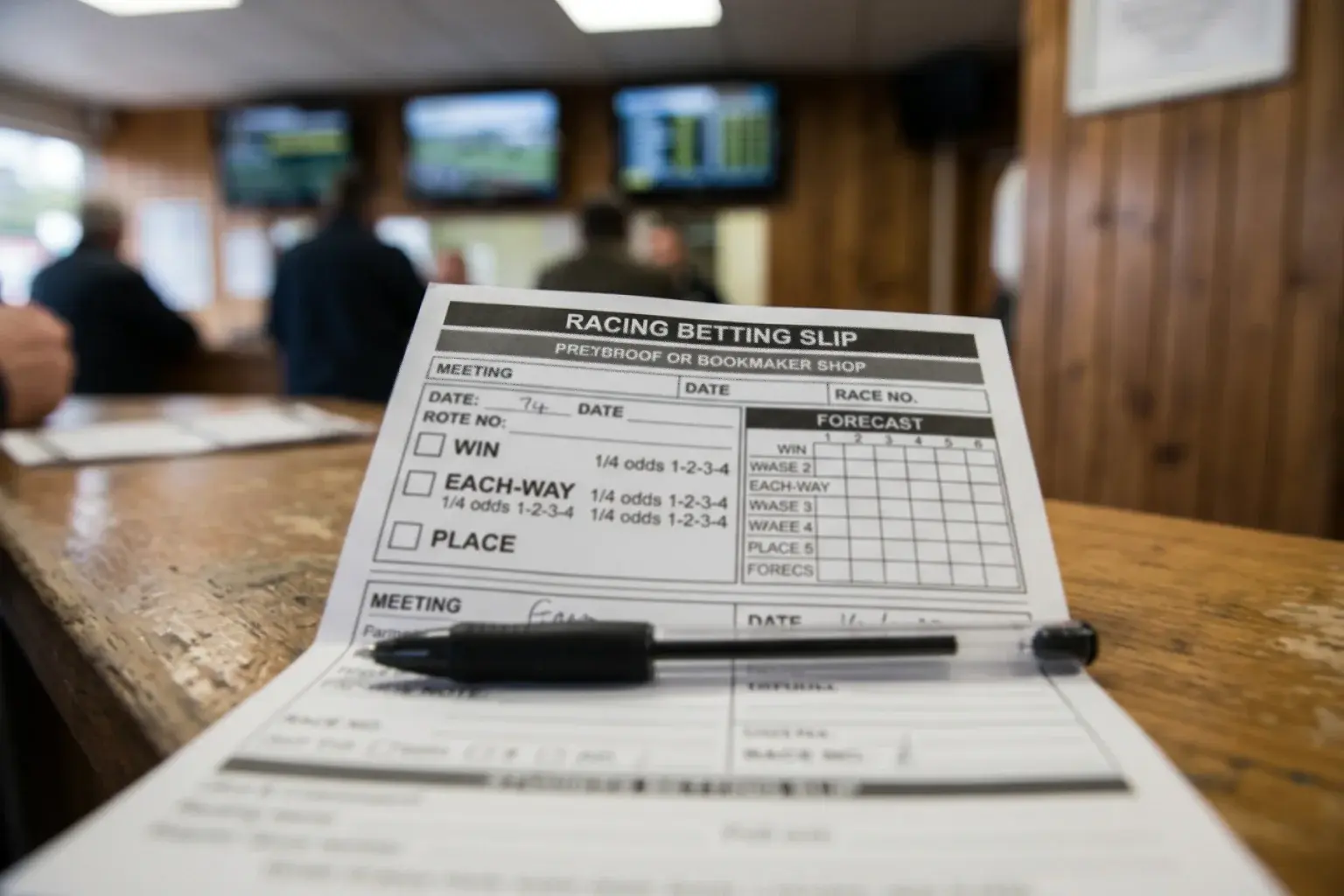
A place bet pays out if your horse finishes in the top two, three, or four (depending on the number of runners and the race type). Place-only betting is underused in my view — in a competitive 16-runner handicap, backing a horse at 10/1 for a place at 1/4 the odds gives you effective place odds of 2.5/1 with a much higher probability of collecting than the win bet. I use place singles when I’m confident a horse will run well but not certain it’ll win.
Each-way is the combination: a win bet and a place bet in one, at equal stakes. A 10-pound each-way bet is 20 pounds total — 10 on the win, 10 on the place. I’ve written a full breakdown of how each-way betting works with return calculations, but the core principle is that each-way transforms a high-risk win bet into a two-part wager where the place portion acts as a safety net. In big-field handicaps with extended place terms, the each-way bet is frequently the smartest structure available.
Forecast and Tricast Bets: Predicting the Exact Finish Order
The first forecast I ever landed was a 2-pound straight forecast at Kempton that returned 187 pounds. I’d identified the first two in the form book, put them in order, and watched them finish exactly as I’d predicted. That feeling — and that return — keeps forecast punters coming back despite the brutal strike rate.
A straight forecast requires you to name the first and second in the correct order. A reverse forecast covers both possible finishing orders between your two selections (and costs double because it’s two bets). A combination forecast extends to three or more selections and covers all possible first-and-second permutations between them — the cost escalates quickly, since three selections generate six combination forecast bets.
Tricasts go one further: name the first three in exact order. Reverse and combination tricasts exist but become expensive fast — a combination tricast with four selections is 24 bets. The payouts can be extraordinary in big fields, but the probability of hitting a straight tricast in a 16-runner handicap is vanishingly small.
My practical rule: forecasts are worth considering in small fields (8 runners or fewer) where you can narrow the finish to two or three realistic contenders. In larger fields, the permutations explode and the edge required to make forecasts profitable becomes unrealistic. Tricasts are entertainment bets — the maths almost never supports them as a serious strategy, though I’ll admit the one time I hit a tricast at Ascot funded a very pleasant dinner.
Multiple Bets: Doubles, Trebles, Accumulators
William Hill’s Lee Phelps described the four days of Cheltenham as an “unrivalled” battle between bookmakers and punters, and nowhere is that battle more lopsided than in accumulators. Multiples are where bookmakers make disproportionate profit, because the compounding effect of the overround across multiple legs works relentlessly in their favour.
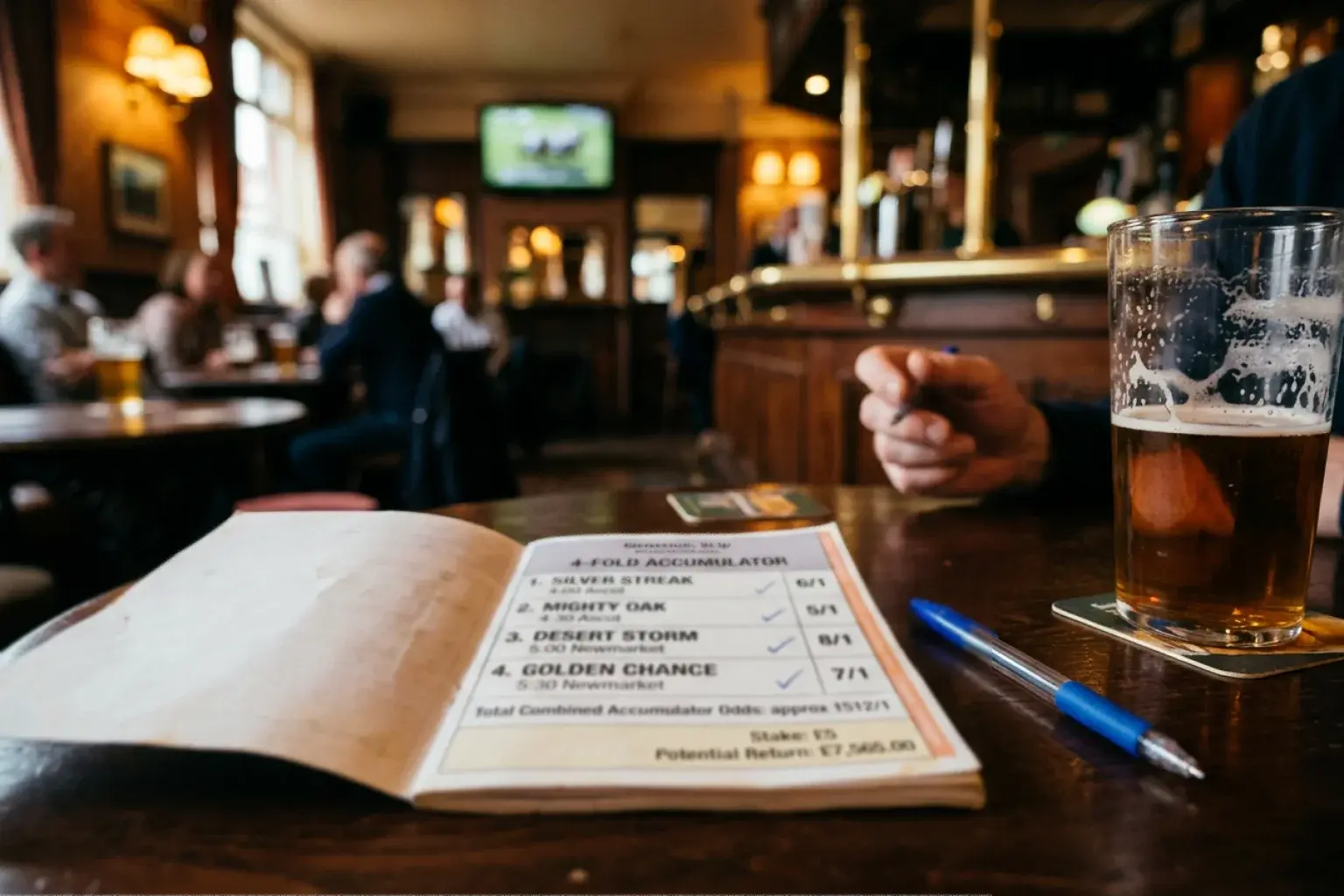
A double combines two selections — both must win for the bet to pay out. Your winnings from the first selection roll onto the second as the stake. A treble does the same with three. An accumulator extends to four or more. The appeal is obvious: a 10-pound four-fold accumulator on four 3/1 shots returns 2,560 if all four win. The reality is less glamorous — the probability of all four winning, even if each is a genuine 3/1 chance, is about 1.5%.
I use doubles occasionally — two strong selections where I want the enhanced return of combining them without the extreme variance of longer accumulators. Trebles and four-folds very rarely. Five-fold accumulators and above, never. The maths simply doesn’t support them as a long-term strategy, and the bookmaker’s compounded margin across five or more legs makes them significantly negative expected value.
If you enjoy accumulators for the entertainment value, be honest with yourself about that — there’s nothing wrong with a small-stake accumulator as a fun bet alongside your serious selections. The mistake is treating accumulators as a strategy rather than what they are: a high-variance lottery ticket.
Combination Bets: Trixie, Patent, Yankee, and Lucky 15
Combination bets are the answer to a question every accumulator punter eventually asks: “What if I could get some return even if one selection lets me down?” They structure multiple doubles, trebles, and optionally singles across a set of selections so that you don’t need all of them to win.
A Trixie is the simplest: three selections combined into three doubles and one treble (four bets total). You need at least two selections to win to get any return. A Patent adds three singles to the Trixie structure (seven bets total), meaning even one winner generates some return, though usually at a loss.
A Yankee covers four selections: six doubles, four trebles, and one four-fold (11 bets). A Lucky 15 adds four singles (15 bets total). A Lucky 31 covers five selections across 31 bets. The numbers escalate fast — a Lucky 63 on six selections is 63 bets, and even at a pound a bet, that’s a serious outlay.
The practical value of combination bets lies in the insurance they provide against a single loser. If you’ve identified three strong selections across different meetings and want to combine them without the all-or-nothing risk of a treble, a Trixie gives you profit from any two winning while adding the treble as a bonus. I use Trixies perhaps once a month during busy Saturday cards where I have three strong-conviction picks.
The trap is the total stake. A 2-pound Trixie costs 8 pounds. A 2-pound Lucky 15 costs 30 pounds. Punters who would never place a 30-pound single bet don’t flinch at a 2-pound Lucky 15 because it doesn’t feel like a 30-pound outlay — but it is, and your bankroll treats it that way regardless of how it’s structured.