
Grand National Betting: Accessing Top Markets
My first horse racing bet was a disaster. Not because the horse lost — it actually won — but because I’d accidentally placed a forecast instead of a win single, picked the wrong second horse, and collected nothing. I’d stared at the bet slip for a full minute, clicked the wrong option, and didn’t realise until the race was over. That confusion is universal among new punters, and it’s entirely fixable with about ten minutes of preparation.
Around 12 million people in the UK bet on the Grand National every year, and roughly 30% of them are first-time or once-a-year punters. General gambling participation sits at 48% of UK adults in any given four-week period, with 27% participating in something other than the lottery. Horse racing is the gateway for millions, particularly around the big festivals, and the learning curve from “I fancy that horse” to “I’ve placed a confident bet” is shorter than most people expect.
This guide strips away the jargon and walks through the process from reading a racecard to understanding what your bet slip actually means. No assumptions about prior knowledge, no patronising simplifications — just the practical steps that would have saved me from that forecast fiasco.
Once you understand the basics of picking a winner, learning how each-way horse racing bets work can provide a safer alternative for big-field handicaps.
How to Read a Horse Racing Racecard
The racecard looks intimidating the first time you see it. Numbers, abbreviations, symbols, form figures — it’s a compressed data sheet that packs a horse’s entire recent history into a single line. Once you know what each element means, it becomes the most useful tool in racing.
Every racecard lists the runners in order, with each horse showing: its name, age, weight carried, the trainer’s name, the jockey’s name, the owner’s colours (silks), and a form string. The form string is the most important element for betting purposes. It reads as a sequence of digits and letters showing the horse’s finishing positions in its most recent races, read right to left (most recent on the right). A form string of “321” means the horse finished third, then second, then first in its last three runs — a pattern of improvement.
Key form characters: “1” to “9” are finishing positions; “0” means finished outside the first nine; “F” means fell; “U” means unseated the jockey; “P” means pulled up; “R” means refused; a dash “/” separates different seasons. The more recent the form, the more weight it carries in your assessment.
Beyond form, the racecard shows the going preference (what ground conditions the horse handles best), the draw position (relevant in flat racing, where inside or outside positions can confer an advantage depending on the course), and sometimes a trainer’s recent strike rate. I’d suggest studying three or four racecards before you place your first bet — not to become an expert, but to get comfortable with the layout so you’re not deciphering it under time pressure.
Placing Your First Bet: Account, Deposit, and Bet Slip
Opening a betting account takes about five minutes. You’ll need an email address, a UK address, and a form of identification — usually a driving licence or passport. The range of bet types can wait; for your first bet, a simple win single is all you need.
Every UKGC-licensed operator accepts standard UK payment methods: debit card, bank transfer, or e-wallets. Credit card gambling has been banned in the UK since 2020. Minimum deposits are typically 5 to 10 pounds. I’d recommend starting with the minimum deposit rather than loading a large amount — get comfortable with the platform first.
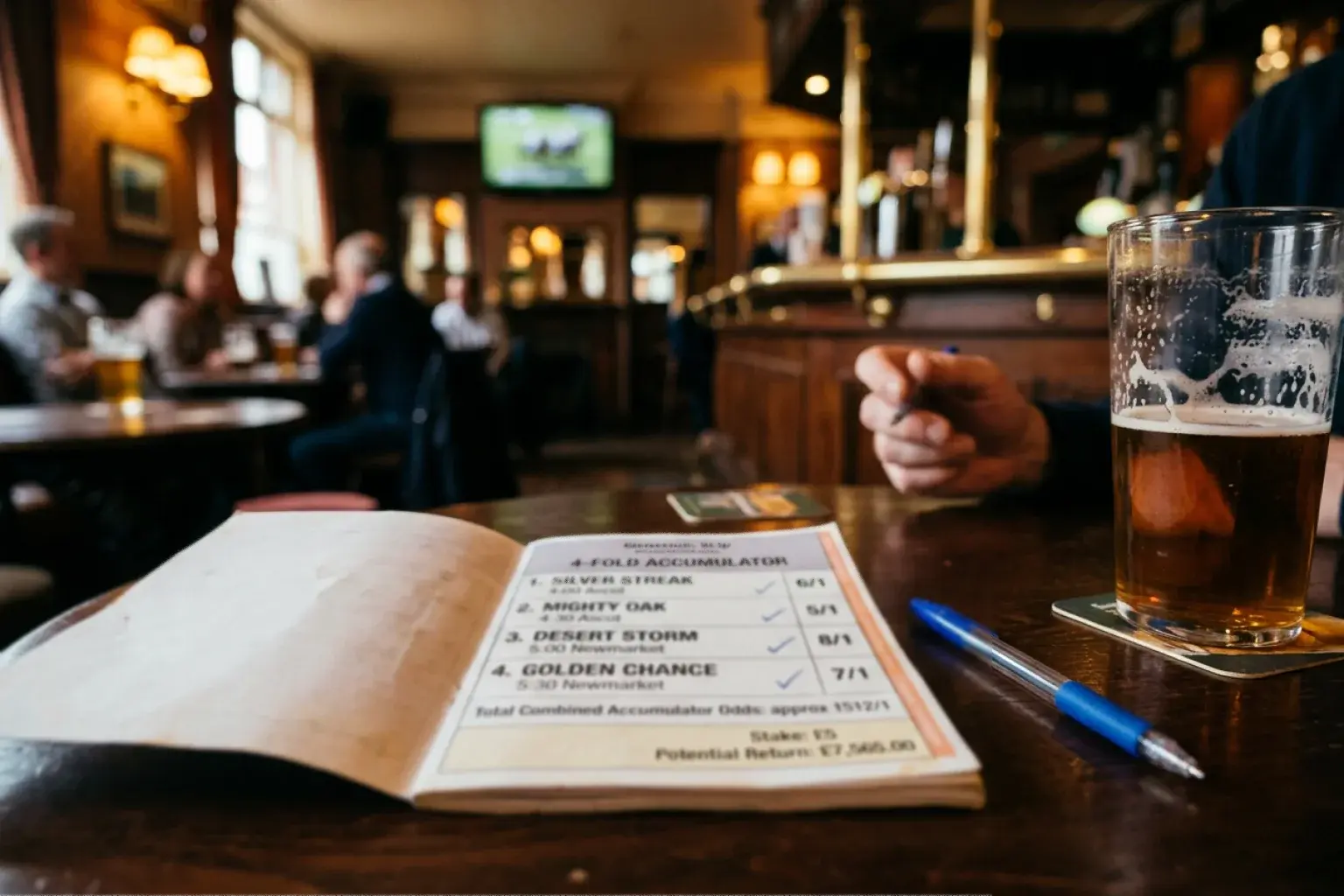
The bet slip is where most beginners get confused. When you click on a horse’s odds, it appears on your bet slip (usually on the right side of the screen or bottom of the mobile app). You then enter your stake — the amount you want to bet. The bet slip shows your potential return, which is the stake multiplied by the odds plus your stake back. A 5-pound bet at 4/1 shows a potential return of 25 pounds (20 profit plus 5 stake).
Before confirming, check three things: the horse name is correct, the bet type is “win” (not each-way, forecast, or anything else unless you intend it), and the odds shown match what you expected. Odds can change between the moment you add a selection and the moment you confirm the bet — most bet slips will flag this with a notification. Once confirmed, the bet is live and your stake is deducted from your account balance.
Understanding Odds: What Fractional and Decimal Prices Mean
UK racing traditionally uses fractional odds — 5/1, 9/2, 11/4. The first number is what you win per unit of the second number staked. At 5/1, you win 5 pounds for every 1 pound staked. At 9/2, you win 9 for every 2, which is 4.50 per pound. At 11/4, you win 11 for every 4, or 2.75 per pound.
Decimal odds, used by exchanges and available as an option on most bookmaker sites, express the total return per pound staked including your stake. Fractional 5/1 becomes decimal 6.0 (5 profit + 1 stake). Fractional 9/2 becomes 5.5. Fractional 11/4 becomes 3.75. I switched to decimal odds years ago because the maths is cleaner — multiply your stake by the decimal price and you have your total return, no additional calculation needed.
SP — starting price — is the industry-determined price of a horse at the moment the race begins. If you don’t lock in a fixed price when placing your bet (or if you deliberately choose “SP”), you’ll be paid at whatever the starting price turns out to be. For beginners, I’d recommend taking a fixed price rather than SP, because you know exactly what you’ll be paid if you win. As you gain experience, understanding when SP might be better than the fixed price becomes part of your decision-making toolkit.
Start your journey safely by choosing a trusted platform from our top-rated horse racing bookmakers list.
Five Common Beginner Mistakes to Avoid
I’ve made every one of these, so consider this advice paid for in personal experience rather than theory.
First: betting on every race. A Saturday card might have 30 or more races across multiple meetings. Feeling like you need a bet in each one is the fastest path to losing money. I now bet in perhaps 15-20% of available races — only when I’ve identified a specific reason to back a particular horse.
Second: ignoring the going. A horse with brilliant form on firm ground running on heavy ground is a different proposition entirely. The going report is published on the morning of racing and updated if conditions change. Check it before every bet.
Third: chasing losses. You lose three bets and double your stake on the fourth to “get it back.” This is the single most destructive pattern in betting, and it affects experienced punters as much as beginners. Set a daily loss limit before you start and stick to it absolutely.
Fourth: backing short-priced favourites without understanding the value. A horse at 1/3 needs to win 75% of the time to be profitable at that price. Favourites win roughly 30-35% of all UK races. Short prices are not safe bets — they’re often the worst value in the market.
Fifth: not understanding each-way terms before placing an each-way bet. An each-way bet is two bets, not one, and costs double your stated stake. I’ve seen new punters confused about why 10 pounds each-way deducted 20 from their account. Know what you’re buying before you buy it.