

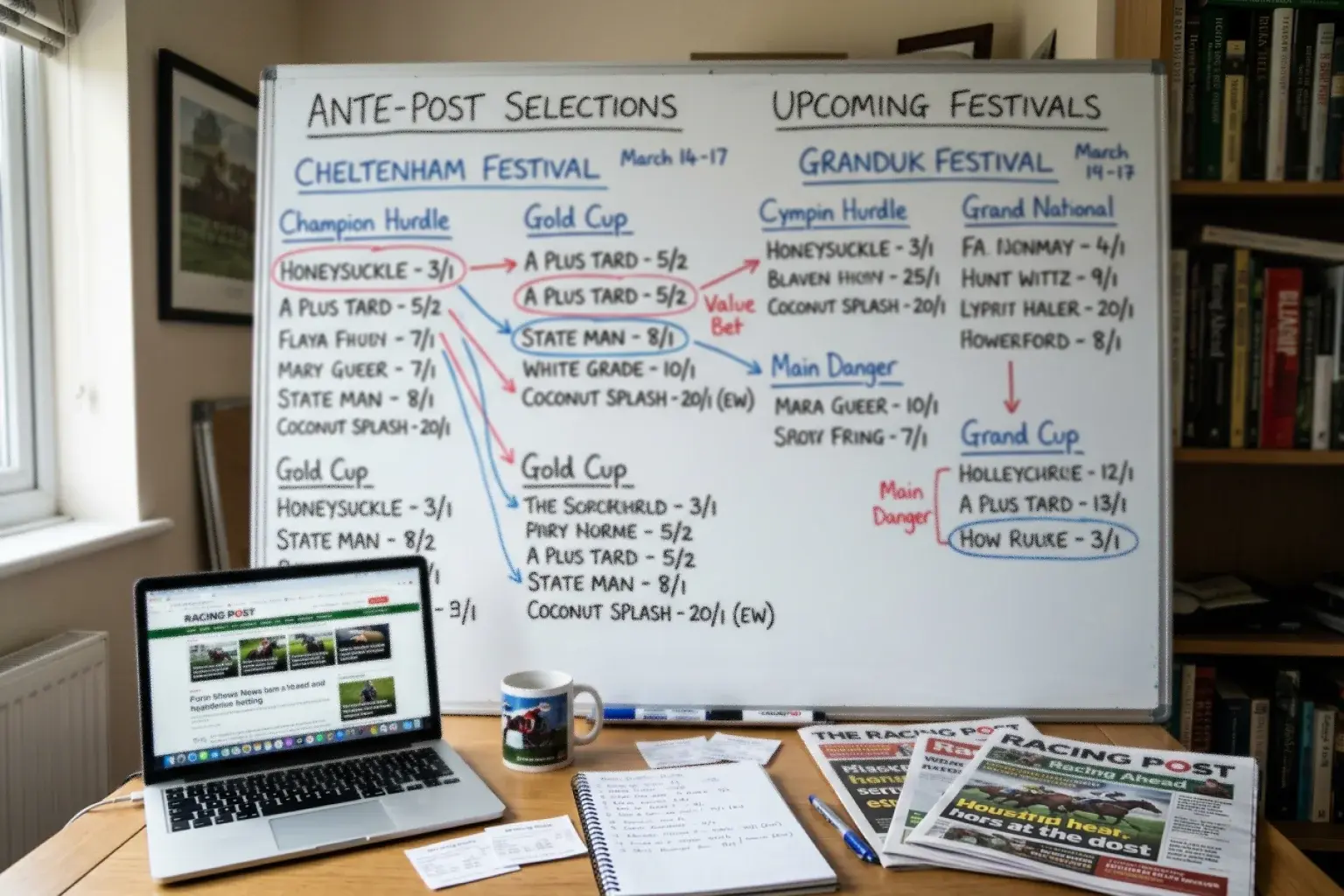
Ante-Post Value: Securing Higher Prices Before Declarations
In October 2024, I backed a novice hurdler for the Supreme at 20/1. By Cheltenham week, it was 7/2. That kind of price compression happens every season, across dozens of horses, and it’s the single most compelling reason to engage with ante-post markets. William Hill projects around 450 million pounds in total betting turnover for the four days of Cheltenham Festival alone — a significant chunk of that flows through ante-post channels in the months before the meeting.
Ante-post betting means placing a wager before the day of the race, typically weeks or months in advance. The defining feature is the price: early markets offer longer odds because they build in uncertainty — will the horse stay sound, will it even be entered, will the ground suit? That uncertainty is your compensation for taking on non-runner risk, and in racing, it’s one of the few genuine structural edges available to anyone willing to do their homework early.
How Ante-Post Markets Differ from Day-of-Race Betting
The gap between ante-post and day-of markets isn’t just about price. It’s about information asymmetry, liquidity, and risk distribution, and understanding all three changes how you approach early betting.
In ante-post markets, the bookmaker is pricing uncertainty as much as ability. A horse that’s clearly talented but has a history of leg problems might be 8/1 ante-post for a race three months away, reflecting both its ability (worth 4/1) and the injury risk (which inflates the price). If that horse makes it to race day healthy, it’s suddenly 7/2 or shorter. The ante-post punter who took 8/1 has captured the risk premium — the extra value that compensated for the possibility of the horse never running.
Liquidity is thinner in ante-post markets, which is both a risk and an opportunity. Thinner markets mean prices can be more volatile — a single large bet can shift an ante-post price dramatically. But it also means the market is less efficient, with more scope for mispricing. All 28 Cheltenham Festival races featured in the year’s top 31 by betting turnover, but in December, many of those races have ante-post markets with a fraction of the liquidity they’ll carry in March.
The critical difference: non-runner no bet (NRNB) terms are not standard in ante-post markets. If your selection doesn’t run, your stake is lost. Some bookmakers offer NRNB on specific races during promotional periods, but as a default, ante-post means accepting the full risk of a non-runner. I factor this into my staking by reducing my ante-post stakes to roughly 60% of what I’d place on the same horse on race day.
The Non-Runner Rule: What Happens to Your Stake
I’ve lost ante-post stakes to injuries, to supplementary entries that changed the race dynamic, to trainers deciding a different race was more suitable, and once to a horse that simply wasn’t good enough to be entered. Every one of those losses stung, and every one of them was the price I paid for the enhanced odds I’d taken.
When your ante-post selection is a non-runner, your bet is void and the stake is not returned. There’s no Rule 4 deduction, no reallocation — the bet simply stands as a loss. This is the core trade-off of ante-post betting, and it’s non-negotiable at standard terms.
The exception is NRNB promotions, which some operators run on major festivals. These give you a full refund (usually as a free bet) if your selection doesn’t run. NRNB ante-post bets typically carry shorter odds than standard ante-post — the bookmaker prices in the insurance — but for punters who want to engage with early markets without the full non-runner risk, they’re a sensible middle ground.
My approach to managing non-runner risk is statistical rather than emotional. In major festivals like Cheltenham, approximately 85-90% of horses that are prominent in the ante-post market in January actually make it to the festival. That means roughly one in eight to one in ten ante-post bets will be lost to non-runners. I build that attrition rate into my seasonal staking plan — if I place 20 ante-post bets across the season, I expect to lose two or three to non-runners and price that into my overall return expectations.
When Ante-Post Offers the Best Value: Timing Windows by Event
HBLB Chief Executive Alan Delmonte noted that the months of February and March 2025 saw bookmakers’ gross profits “well above recent norms,” with March reflecting particularly bookmaker-friendly results at Cheltenham. That observation cuts both ways: when bookmakers do well, it means punters as a group did badly — but the ante-post punters who locked in value months earlier weren’t exposed to the same race-day dynamics.
The optimal ante-post window varies by event type. For Cheltenham, I find the best balance of information and price between late November and mid-January. By this point, the current season’s form has begun to clarify the picture — key trial races have been run, trainers have mapped out target races, and the market has formed initial views. But prices haven’t yet compressed to day-of-race levels because enough uncertainty remains to keep them generous.
For the Cheltenham Festival specifically, the ante-post market goes through distinct phases: opening prices (May to September), early season form response (October to November), mid-season recalibration (December to January), and the final squeeze (February to March). Each phase carries different risk-reward characteristics, and the punter who takes a price in phase two or three is typically capturing the most value per unit of risk.
For handicaps, the timing is different. Ante-post handicap markets don’t develop meaningful liquidity until the weights are published and the entries confirmed, which is usually four to six weeks before the race. Backing a handicapper ante-post before weights are known is essentially betting blind on the handicapper’s assessment, and that’s a gamble within a gamble.
Royal Ascot follows a similar pattern to Cheltenham but compressed into a shorter window. The flat season trials in April and May inform the ante-post Ascot market, with the best prices available in the two to three weeks after the Guineas meetings at Newmarket. By the time the five-day declarations for Ascot are made, the significant price compression has already occurred.