
Going Allowances: Exploiting Market Overreactions
Royal Ascot 2019. I’d spent a week studying form, identified what I believed was a strong bet in the Gold Cup, and backed it on the Monday morning at a price I was thrilled with. Then it rained. Not gently — properly rained, for two days straight. The going changed from Good to Soft, and my selection — a horse with a perfect record on fast ground and no form on soft — finished last of twelve. The winner was a 20/1 shot with a Soft ground record that screamed from the form book if you’d bothered to check.
That was the day I stopped treating going descriptions as background information and started treating them as the single most important variable in race assessment. Ground conditions affect race times by seconds, not fractions. They change which horses are advantaged, which running styles prevail, and which form lines are relevant. Ignore the going and you’re analysing a different race from the one that actually takes place.
The Going Scale and What Each Description Means
British racecourses describe going on a scale from Hard through Firm, Good to Firm, Good, Good to Soft, Soft, to Heavy. All-weather surfaces use Standard, Standard to Slow, and Slow. Each step on the scale changes the racing surface fundamentally.
Firm ground is fast ground. The turf is dry, the surface is unyielding, and horses cover the distance in quicker times. Speed horses thrive — animals with a high cruising speed that can gallop efficiently without expending excess energy fighting the surface. Joint and leg stress increases on firm ground, which is why some trainers withdraw their horses when the going dries out.
Good ground is the default — the most common going description in the British summer, and the surface that most form data reflects. Horses that perform consistently on Good going are sometimes described as “Good-ground horses,” though this is slightly misleading. They’re horses whose ability is best expressed on a surface that neither impedes nor assists them beyond the baseline.
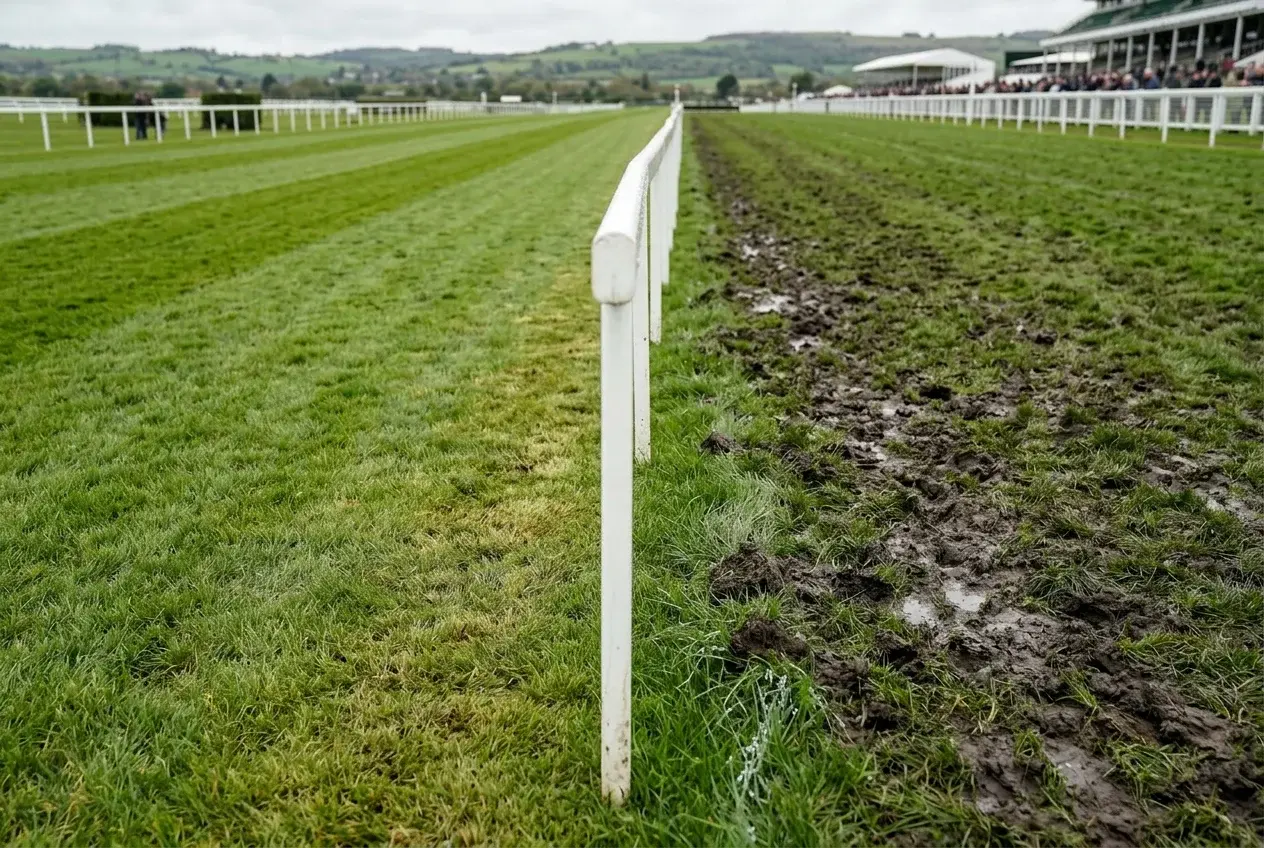
Soft and Heavy ground test stamina above everything. The surface grabs at hooves, each stride demands more energy, and horses without the constitution for a slog simply empty out in the final quarter mile. Staying power, a low action that cuts through the ground rather than slapping on top of it, and a pedigree that suggests stamina on the dam’s side — these become the dominant selection criteria. Race times on Heavy ground can be 15-20 seconds slower than on Firm over the same course and distance. That’s an eternity in racing terms.
How Going Preferences Hide in the Form
Not every going preference is obvious. Some horses clearly love soft ground — they win on it, run poorly off it, and their breeding screams stamina. Others have subtler relationships with the surface that only emerge when you dig into the form with going conditions overlaid on every run.
I use a simple system. For any horse I’m assessing, I split their form into going categories and calculate an average finishing position for each. A horse that averages 2.5 on Good to Soft but 6.3 on Good to Firm has a pronounced preference, even if individual results muddy the picture. This takes three minutes of work per horse and provides information that the betting market consistently undervalues.
Breeding offers additional clues. Sires pass on ground preferences with surprising consistency. A sire whose offspring perform 15% better on soft ground than on firm will produce a disproportionate number of soft-ground specialists. The dam’s side matters equally — the sire of the dam often determines stamina capacity, which directly influences whether a horse handles testing conditions. Experienced form readers maintain mental lists of “soft-ground sires” and “firm-ground sires” that shortcut this analysis.
Action — how a horse physically moves — is the visual confirmation. A horse with a round, high knee action tends to handle soft ground because that motion lifts the hoof cleanly out of the surface on each stride. A horse with a low, daisy-cutting action covers firm ground efficiently but gets trapped in soft going because its stride doesn’t generate enough lift. Watching a horse move during the pre-race coverage, particularly on the way to post, can confirm or contradict what the form data suggests about ground suitability.
Going Changes and Market Overreactions
Overnight rain before a major meeting creates some of the best betting opportunities in racing. When the going changes from Good to Firm to Good to Soft between the evening and the morning of a race, the market reprices — but it rarely reprices correctly.
Favourites established on the assumption of fast ground suddenly face conditions that don’t suit them. Their price drifts, but often not far enough. Meanwhile, horses at the back of the market whose form on soft ground is demonstrably better see their prices shorten, but often not to the level their going-adjusted form deserves. The market moves, but it moves sluggishly because most casual bettors don’t reassess their selections based on going changes. They backed a horse on Wednesday and they’re sticking with it on Saturday regardless of conditions.
All 28 Cheltenham Festival races rank in the top 31 by turnover in British jump racing, and the going at Cheltenham is famously variable — it can change from Good to Soft on the New Course to Soft on the Old Course within the same afternoon. Punters who monitor going reports throughout the day and adjust their assessments accordingly have a structural advantage over those who made their selections the night before and never looked again.
I check the going three times: the evening before, two hours before the first race, and immediately after any watering or rain during the meeting. Each check is an opportunity to find value that’s opened up since the last one. The official going description is the starting point, but GoingStick readings (a measurement of ground penetration) offer more granular data at courses that publish them. A change from 7.2 to 6.5 on the GoingStick tells you more than a verbal description shift from “Good” to “Good to Soft” because it quantifies what the words leave vague.
All-Weather Surfaces and the Different Rules
All-weather racing operates under different going dynamics, and confusing the two surfaces is a common error. Polytrack, Tapeta, and Fibresand are the three artificial surfaces used in British racing, and each plays differently.
The going on all-weather tracks varies less dramatically than on turf, but it does vary. Rain can make Polytrack ride slightly slower, while Fibresand at Southwell is always the deepest and most stamina-testing all-weather surface. Treating all-weather as a single category is like treating Chester and Ascot as interchangeable. They’re not.
Some horses that struggle on turf thrive on all-weather surfaces, and vice versa. A horse with poor turf form but a strong all-weather record isn’t a bad horse — it’s a horse being asked the wrong question on the wrong surface. The form guide distinguishes between turf and all-weather performances, and this distinction should be central to your assessment. For punters who focus on reading form systematically, surface analysis is one of the highest-value layers to add to the process.