

Handicap Ratings: Capitalizing on Competitive Racing Odds
I spent my first two years betting on horse racing convinced that the best horse should win. It took a particularly painful Saturday at Ascot — four favourites beaten, one by a horse carrying a stone less — to understand that handicap racing isn’t about finding the best horse. It’s about finding the horse whose ability exceeds its official rating by the widest margin.
The British Horseracing Authority employs a team of handicappers whose job is to allocate a weight to each horse based on its perceived ability. A horse rated 95 carries more weight than one rated 80, and the difference is designed to equalise their chances. In theory, every runner in a handicap should cross the line together in a dead heat. In practice, handicappers work with imperfect information and the system creates exploitable gaps — if you know where to look.
Handicap races make up the bulk of the UK racing programme. The big Saturday feature races, the valuable festivals, the Grand National itself — these are all handicaps. With 48% of the adult UK population engaging in some form of gambling and horse racing remaining the most bet-upon sport after football, understanding handicaps is not a niche skill. It’s the central skill of serious racing betting.
To consistently beat the bookies in these competitive events, you must deeply analyze horse racing official weight ratings and spot anomalies.
How the Handicapper Builds the Weights
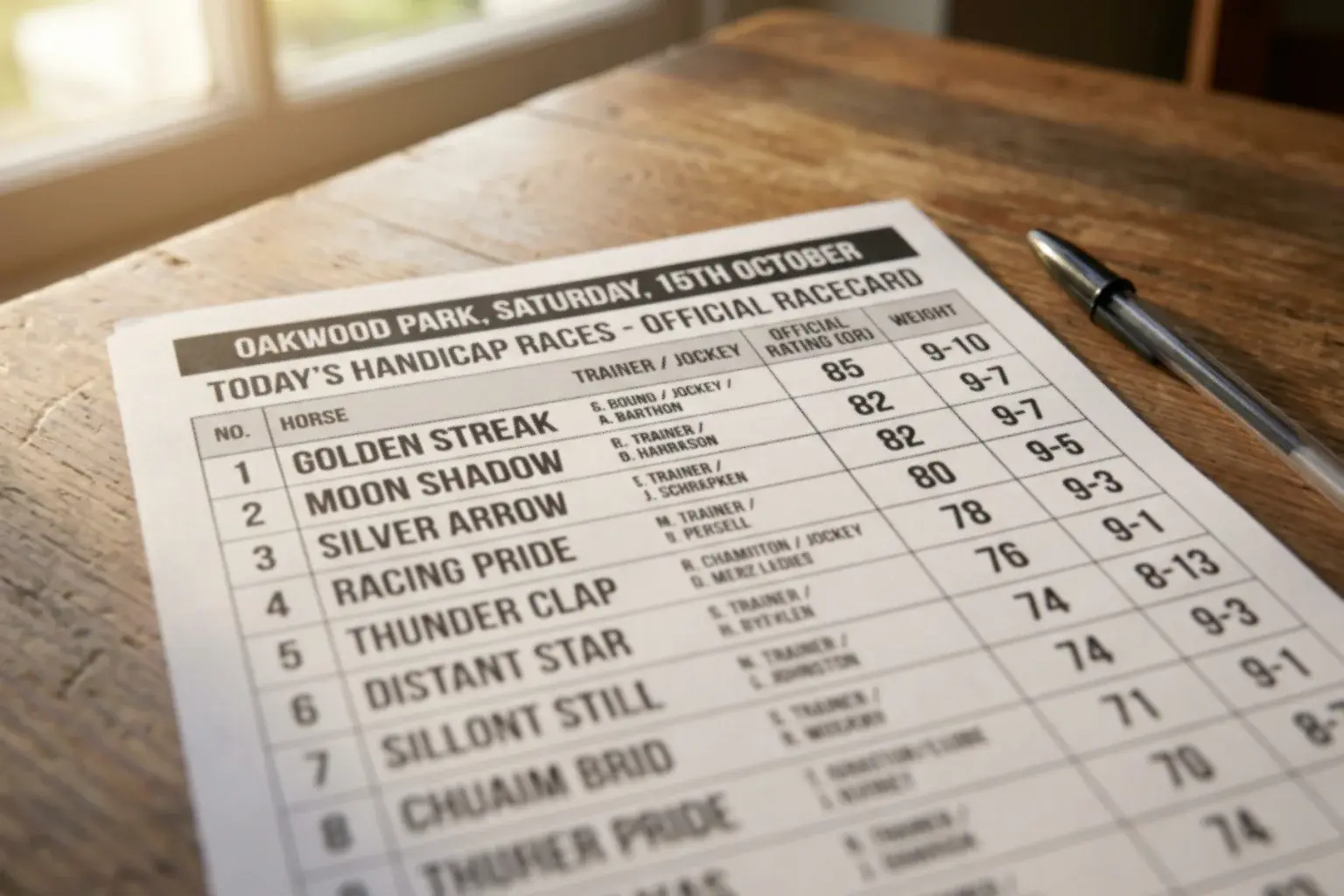
Every horse that runs in a handicap carries a rating expressed in pounds. This rating is assigned by the BHA handicapper after reviewing race performances, and it directly determines the weight a horse carries. A horse rated 100 in a race where the top weight is set at 100 will carry 10 stone. A horse rated 85 in the same race carries 8 stone 11 pounds — fifteen pounds less, reflecting the handicapper’s assessment of the fifteen-pound ability gap.
The standard rule of thumb — and it holds up well across decades of data — is that one pound of weight is worth roughly one length over a mile. So a horse rated 85 receiving fifteen pounds from a horse rated 100 is expected to finish level with it. If the 85-rated horse wins by three lengths, it was effectively running to a rating of 103 — eighteen pounds better than the handicapper thought.
The handicapper adjusts ratings after every performance. Win a handicap convincingly, and your rating goes up, which means more weight next time. This creates the central dynamic of handicap betting: the horse that won last time often represents worse value this time because it’s been reassessed. The horse that ran a solid fourth after encountering traffic problems might represent far better value because the bare result understates its true performance.
Spotting Horses on an Upward Curve
The most profitable horses in handicap betting are those whose ability is improving faster than the handicapper can react. A four-year-old that’s strengthened over the winter and returns in spring fitter and faster than its autumn form is running off a rating that’s already out of date.
Trainer patterns are the first clue. Certain yards are known for bringing horses back from a break in peak condition, targeting specific races with military precision. When a trainer who wins 30% of their handicap starts sends out a horse that’s been off for ten weeks and drops it in class, the form book won’t tell you much. The trainer’s methodology tells you everything.
The second clue is sectional timing where available. Two horses can finish the same race four lengths apart, but if the one that finished fourth was five lengths behind at the two-furlong pole and closed at a visibly faster pace, it ran a stronger race than the bare result suggests. Sectional data is increasingly available for major UK tracks, and it’s the single most underused tool in handicap assessment.
Young horses — three and four-year-olds running against older rivals — carry automatic weight allowances because they’re still physically developing. These allowances are generous, and in the spring and early summer when young horses are improving week to week, the allowance combined with natural improvement creates a double advantage. The statistics bear this out: lightly raced four-year-olds in spring handicaps produce a higher strike rate than their odds would suggest.
Class Drops, Weight Changes, and the Market’s Blind Spots
Here’s a scenario I encounter almost every week: a horse drops from a Class 2 handicap to a Class 4, shedding eight pounds off its weight in the process. The form figures from its Class 2 runs look poor — beaten six lengths, beaten ten lengths. But the quality of opposition it was facing was dramatically higher. Translate those beaten distances through the class prism, and the horse is suddenly well treated at the lower level.
The betting market handles class drops inconsistently. High-profile drops — a horse that recently ran in a Group race appearing in a handicap — attract attention and the price shrinks accordingly. Quiet drops within the handicap system — Class 3 to Class 4, or a switch from a hot London track to a quieter northern venue — often slip under the radar. These are the moves where value lives.
Weight is relative, not absolute. A horse carrying 9 stone 7 in a strong Class 2 handicap at York is running against a different calibre of rival than a horse carrying the same weight in a Class 5 at Wolverhampton. Never assess weight in isolation. Always ask: what level of opposition does this weight pit the horse against?
Alan Delmonte, the HBLB chief executive, noted that bookmaker profits from racing in early 2025 told a story about how the market has tightened. The average betting turnover per race dropped 8% in 2024/25, with the decline steeper still — 19% — compared to the 2021/22 season. Punters are being more selective with their money, which means the pricing on popular handicap runners has become more efficient. Edge now lives in the less-obvious angles: the low-profile class drops, the first-time headgear applications, the stable switches that signal renewed ambition.
Apply your handicapping knowledge at trusted UK horse racing bookies that offer extra places on big-field events.
Practical Handicap Betting Without Overthinking
After all the analysis, handicap betting still comes down to a handful of questions. Is this horse rated below its current ability? Has something changed since its last run that the market hasn’t fully priced in? Is the weight it carries fair for the level it’s competing at?
I keep a shortlist of horses I believe are ahead of their handicap mark. Some won’t run for weeks. When they do appear in a race that suits their profile — right distance, right ground, right class level — I bet with conviction rather than spreading small stakes across every race on the card. Three or four confident handicap bets per week will outperform thirty speculative ones over any meaningful sample. Each-way betting in large-field handicaps amplifies this approach, and understanding how each-way terms work is essential before wading into 20-runner fields where the place element often carries more expected value than the win.