

Horse Racing Free Bets: Evaluating True Bonus Value
I once watched a punter celebrate a “free” 20-pound bet like he’d found money in an old jacket. Two days later, after wading through wagering requirements, he’d turned that 20 into precisely 6.40. That gap between the headline number and what actually lands in your account is where the real story of free bets lives.
Free bets are marketing tools. That’s not cynicism — it’s just how the economics work. With over 120 licensed operators competing for UK punters and the total number of licensed betting shops dropping to 5,825 by March 2025, the online fight for new accounts has never been more aggressive. Every operator needs sign-ups, and free bets are the sharpest hook they have.
The problem is that most guides treat free bets like gifts. They’re not. They’re conditional instruments with rules that slash their face value by 50-70% on average. A 20-pound free bet with stake-not-returned terms and a 3x wagering requirement on winnings is worth closer to 5-8 pounds in real extractable value. I’ve done the maths across dozens of offers over the years, and that range holds remarkably steady.
What matters isn’t the size of the free bet. It’s the terms that come bolted on — and whether you know how to navigate them before you deposit a penny.
Current Free Bet Offers for Horse Racing Punters
The landscape shifts constantly, but the structural patterns of 2026 offers are clear. Most welcome packages for horse racing fall into three categories: bet-and-get (place a qualifying bet, receive free bets), deposit-match (deposit X, get X in free bets), and enhanced odds (boosted price on a specific race with winnings paid as free bets).
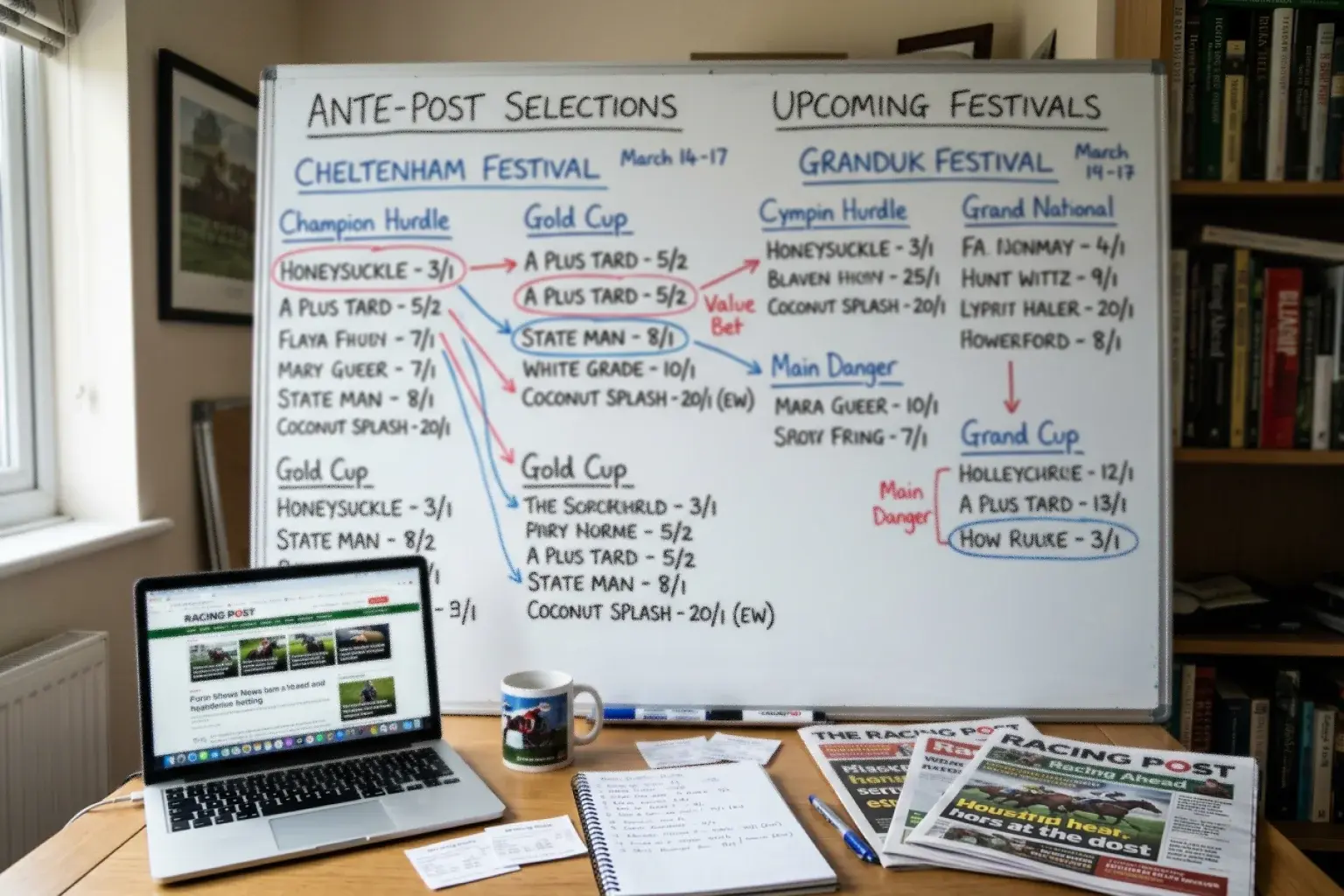
Bet-and-get dominates. The typical structure runs something like “bet 10, get 30 in free bets” or “bet 10, get 40 in free bets split across four 10-pound tokens.” A few operators have pushed to 50 or even 60 in total free bet value during major festival periods — Cheltenham and Aintree being the obvious peaks.
Here’s what I’ve noticed tighten over the past two years: minimum odds requirements on the qualifying bet have crept up. Where 1/2 was once enough to trigger most offers, many operators now demand evens or higher. That subtle shift changes the qualifying bet from a near-certainty into something with genuine risk. A 10-pound qualifying bet at 1/2 is a very different proposition from 10 pounds at evens, yet both unlock the same free bet package.
Deposit-match offers are rarer for racing than for casino, but they surface periodically. They tend to carry heavier wagering multipliers — 5x to 8x isn’t unusual — which makes them the worst value category for punters who plan to use free bets on horse racing rather than slots.
Enhanced odds offers crop up around marquee races. You’ll see an operator advertising 30/1 on a Cheltenham favourite that the general market prices at 5/1. The catch: winnings above the standard price are paid in free bets, not cash, and those free bets carry their own wagering layer. It’s a nested set of conditions, and the headline price is almost never what you’ll walk away with.
Wagering Requirements, Expiry, and Stake-Not-Returned Rules
Three years ago, I started tracking the actual cash output of every free bet I used across a racing season. The single biggest value-killer wasn’t wagering multipliers — it was expiry windows. I lost more free bet value to offers that expired after 72 hours during a quiet midweek period than to any other single factor.
Stake-not-returned is the standard across nearly all UK racing free bets in 2026. When you place a 10-pound free bet at 5/1 and win, you receive 50 pounds in winnings — not 60. The stake itself vanishes. This is the single most important mechanic to understand because it cuts the expected value of every free bet by the probability-weighted stake amount. On average, stake-not-returned reduces a free bet’s real value to roughly 70% of its face value before any other conditions apply.
Wagering requirements on free bet winnings add another layer. A 1x turnover requirement is generous and increasingly rare. Most operators now attach 3x to 5x wagering, meaning if you win 50 from a free bet, you need to wager 150 to 250 before withdrawing. Each turnover cycle carries the house edge, so every additional multiplier shaves another 3-5% off your expected return.
Expiry windows range from 72 hours to 30 days. Seven days is the most common. If you’re claiming a free bet during a period with no racing that interests you, the pressure to use it on a race you haven’t properly assessed is itself a cost — not a financial one, but a decision-quality one. I’d rather let a 10-pound free bet expire than force it onto a race where I have no edge.
Some offers also restrict the markets where free bets can be placed. “Horse racing only” sounds fine until you discover it excludes ante-post markets or exchange bets. Always check whether the free bet works on the specific bet type you intend to use.
How to Extract Maximum Value from Free Bets
The maths here isn’t complicated, but it does require discipline. I treat free bets differently from my regular bankroll because the optimal strategy for a stake-not-returned bet is genuinely different from how you should bet with your own money.
With stake-not-returned, you only profit from winnings. This means the expected value of a free bet increases with higher odds. A 10-pound free bet on a 1/1 shot yields 10 profit if it wins — 50% probability gives an expected return of 5 pounds. The same free bet on a 5/1 shot yields 50 profit if it wins — roughly 16% probability for an expected return of about 8 pounds. Higher odds, higher expected value. This is the opposite of conservative bankroll management with your own cash.
The sweet spot sits somewhere between 4/1 and 8/1 for single free bets. Above 8/1, the variance becomes extreme — you’ll need many free bets at those prices before the expected value converges to reality. Below 4/1, you’re leaving money on the table relative to what the free bet could return.
For each-way free bets (where the operator allows them), the calculation shifts. An each-way free bet effectively becomes two free bets — one on the win, one on the place. The place portion at 1/4 or 1/5 odds provides a higher hit rate, smoothing out variance while the win portion carries the upside. I’ve found each-way free bets on runners priced between 6/1 and 12/1 in big-field handicaps to be the most consistent value extractor.
One more thing: if an offer lets you split free bets across multiple smaller bets rather than one lump sum, take the split. Four 5-pound free bets give you four chances to extract value versus one shot with 20. The variance reduction alone makes this the stronger play, and it lets you spread bets across different meetings and form profiles. Pair this approach with a solid understanding of how Best Odds Guaranteed works and you’ll maximise the return on every token.