
Each-Way Betting: Maximizing Value on Placed Runners
The first time I placed an each-way bet, I had no idea I was placing two bets. I was at Newmarket, a friend nudged me toward a 10/1 shot in a handicap, and I ticked the “each-way” box on the betting slip thinking it was just a fancier way of backing a horse to win. When the horse finished third, I was surprised to see money land back in my account. That accidental education turned out to be one of the most useful things that happened to me as a young punter, because each-way betting, once you understand it properly, is the most flexible and strategically interesting wager available on UK horse racing.
Each-way bets grew by 25% at the 2024 Cheltenham Festival compared with the previous year’s meeting, a surge that reflects both the appeal of big-field handicaps and the increasing sophistication of recreational punters who understand that each-way offers a safety net when backing runners at longer odds. It is not a beginners’ bet or a cautious bet — it is a structural bet with distinct mathematical properties that shift depending on field size, place terms, and the odds of the selection.
What follows is a complete breakdown: the mechanics, the place terms, the return calculations, and — most importantly — the situations where each-way betting delivers genuine value versus the situations where it quietly costs you money.
The Two Bets Inside Every Each-Way Wager
An each-way bet is not one bet. It is two separate bets of equal stake, combined into a single slip. The first bet is a win bet: your horse must finish first for this part to pay out. The second is a place bet: your horse must finish in one of the designated place positions (usually first, second, or third, depending on the number of runners) for this part to pay out.
Because it is two bets, an each-way wager at £5 each way costs you £10 total — £5 on the win and £5 on the place. This is the detail that catches out new punters. If you enter “£5” in the each-way bet slip, you are committing £10 of your bankroll, not £5. Every staking calculation for each-way bets needs to account for this doubling, and failing to do so is one of the most common budgeting errors in recreational betting.
If your horse wins, both bets pay out: you receive the full odds on your win bet plus the place terms on your place bet. If the horse finishes in a place position but does not win, only the place bet pays. If the horse finishes outside the places, both bets lose. The two parts of the wager are settled independently, which means your returns depend on both the horse’s finishing position and the specific place terms in effect for that race.
The place bet is paid at a fraction of the win odds. The standard fraction for most horse races is one quarter (1/4) or one fifth (1/5) of the win odds, depending on the number of runners and the type of race. This fraction is fixed at the time you place the bet and is determined by industry-standard place terms, which I will break down in the next section.
Place Terms: How Many Places Pay and at What Fraction
I spent a confused afternoon at Doncaster once, trying to work out why my each-way bet on a five-runner race had been settled at one-quarter odds for two places, while a friend’s each-way bet on a sixteen-runner handicap the same day paid at one-quarter odds for four places. The answer lies in the standardised place terms that apply across UK horse racing, and they are determined by one factor above all else: the number of declared runners.
The standard terms are these. In races with two to four runners, each-way betting is generally not available — the field is too small to sustain a meaningful place market. With five to seven runners, the place terms are one quarter of the odds for first and second only. With eight or more runners (non-handicap races), the terms extend to one quarter of the odds for first, second, and third. In handicap races with sixteen or more runners, the terms widen further: one quarter of the odds for the first four places. And in certain major handicaps and specific festival races, bookmakers may offer enhanced terms — one quarter or one fifth odds for five or even six places.
The fraction itself is equally important. One quarter (1/4) means the place part of your bet is paid at one quarter of the win odds. If you backed a horse each way at 12/1, the win part pays 12/1 but the place part pays 3/1 (12 divided by 4). One fifth (1/5) means the place part pays at one fifth: 12/1 becomes 12/5 (or 2.4/1) for the place element. The larger the fraction denominator, the less your place bet returns — so 1/4 terms are more favourable to the punter than 1/5 terms.
Place Terms by Field Size and Race Type
The interplay between field size and race type creates distinct each-way landscapes that shape your betting decisions. A five-runner Group 1 flat race offers only two places at 1/4 odds — tight terms where your horse needs to finish in the front pair to return anything on the place element. The maths here can be unfavourable, because at short odds the place returns barely cover your total each-way stake.
Contrast that with a 20-runner Grand National. Around £200 million in bets flow through the Grand National market, and the each-way market is a major driver of that volume. With 40 runners (the maximum National field), bookmakers typically pay four places at 1/4 odds as standard, and many offer promotional extra places — five, six, or even seven places. Roughly 82% of Grand National bets are £5 or less, and most of those are each-way wagers from casual punters hoping their horse hits a place even if it does not win. The economics of each-way betting in a 40-runner handicap are fundamentally different from a small-field flat race: more places, more chances, and more opportunity for the place bet to deliver a positive return.
Handicap races in general — those where the weights are adjusted to equalise the chances of each runner — tend to produce more competitive fields and more unpredictable results. That unpredictability is your friend in each-way betting, because it means horses at bigger odds can hit the places more frequently than the odds imply. A 16/1 shot in a five-runner race has very little place protection. The same 16/1 shot in a 20-runner handicap has four place positions available and a realistic chance of hitting one of them.
Calculating Each-Way Returns Step by Step
The arithmetic of each-way returns is straightforward once you know the formula, but it catches people out because there are multiple moving parts. Let me build it from the ground up with a clean example.
Suppose you back a horse each way at 10/1 for £5 each way (total stake: £10). The race has 12 runners, so standard place terms are 1/4 odds for three places. If the horse wins, you receive: the win bet return of £5 at 10/1 = £50 profit + £5 stake = £55, plus the place bet return of £5 at 10/4 (which is 5/2) = £12.50 profit + £5 stake = £17.50. Total return: £55 + £17.50 = £72.50 from a £10 total stake, for a profit of £62.50.
If the horse finishes second or third (a placed finish), you receive nothing from the win bet, and the place bet return of £5 at 5/2 = £12.50 profit + £5 stake = £17.50. Total return: £17.50 from a £10 total stake, for a profit of £7.50. You staked £10 and got £17.50 back — a modest but positive result, and one that would have been a total loss on a win-only bet.
If the horse finishes fourth or worse, both bets lose. Your total loss is £10. This is the risk side of each-way betting: you lose double the stake of a single win bet when the horse is unplaced.
Worked Examples: 8-Runner, 16-Runner, and Handicap Races
William Hill expects around £450 million to be wagered across the four days of the 2026 Cheltenham Festival. William Hill spokesperson Lee Phelps described the battle with punters over those four days as unrivalled in jump racing. Much of that volume comes from each-way bets on the competitive handicaps and the championship races, so let me walk through how the returns differ depending on the race profile.
In an 8-runner race at 1/4 odds for three places, backing a 6/1 shot each way at £10 each way (£20 total stake): if the horse wins, you get £60 + £10 = £70 on the win part, plus £15 + £10 = £25 on the place part (6/4 = 3/2). Total return £95, profit £75. If placed but not winning: £25 return, profit £5. The place return here barely edges your total stake, which illustrates why each-way betting at short odds in small fields is often poor value — the place element does not compensate enough for doubling your outlay.
In a 16-runner handicap at 1/4 odds for four places, the dynamics shift. A 14/1 shot each way at £10 each way (£20 total stake): win return is £140 + £10 = £150 plus £35 + £10 = £45 on the place. Total £195, profit £175. Place-only return: £45, profit £25. Now the place bet alone delivers a clear profit even against the doubled stake. At bigger odds in larger fields, each-way starts to function as a high-probability partial recovery tool — your horse does not need to win for the bet to return a meaningful amount.
The Grand National, with up to 40 runners and bookmakers often paying five or six extra places, represents the extreme end. A 25/1 shot each way with six places paid at 1/4 odds: place return on a £10 place stake is £10 at 25/4 (6.25/1) = £62.50 + £10 = £72.50. That is a substantial return from the place portion alone, and with six place positions available in a 40-runner field, the probability of hitting a place is considerably higher than the implied odds suggest.
When Does Each-Way Offer Genuine Value
Not every race suits an each-way approach, and the punter who bets everything each way out of habit is leaving money on the table. Over 80% of Cheltenham bets in 2024 were placed through mobile devices, meaning punters are making quick decisions on the go — and the default choice of “each way” requires more thought than most give it in that moment.
Each-way betting offers genuine value in three specific scenarios. The first is big-field handicaps at odds of 8/1 or above with four or more places paid. The combination of multiple place positions and longer odds means the place element has a realistic chance of producing a standalone profit, even when the horse does not win. The implied probability of finishing in the places is often lower than the actual probability, because the place odds are mechanically derived from the win odds rather than independently priced.
The second scenario is when a horse is overpriced for the win but has strong place credentials — a consistent type that hits the frame regularly without winning. These horses are frustrating to back win-only but profitable each-way because the place part collects repeatedly. Over a long series of bets on this type of horse, the cumulative place returns can more than compensate for the additional stake.
The third is festival racing with enhanced place terms. When bookmakers offer five or six places on a major handicap, they are effectively giving each-way bettors better terms than the standard market. The extra places increase the probability of a return without increasing your stake. These promotional terms are most common at Cheltenham, Aintree, and Royal Ascot, and they represent the clearest value opportunity in each-way betting.
Common Each-Way Mistakes and How to Avoid Them
The most expensive mistake is betting each way at short odds in small fields. Backing a 3/1 favourite each way in a five-runner race means your place bet pays at 3/4 odds — less than evens. If the horse finishes second, you get £8.75 back on a £10 total stake. You lose £1.25 despite your horse finishing in the places. The place terms at short odds in small fields are structurally unfavourable, and you are almost always better off backing win-only.
The second mistake is ignoring the doubling of stake. Each-way bets cost twice what they appear to on the slip. A punter who stakes £10 each way on seven races across a Saturday card is committing £140, not £70. Bankroll management must reflect this doubling, and the failure to account for it is a recurring source of unexpected drawdowns.
The third mistake is failing to check whether each-way terms vary between bookmakers on the same race. While standard place terms are consistent, promotional each-way offers — extra places, enhanced fractions — differ by operator. The punter who places an each-way bet without comparing terms across bookmakers may be accepting three places where a rival offers four, losing a substantial edge on the place element for the sake of a thirty-second price check.
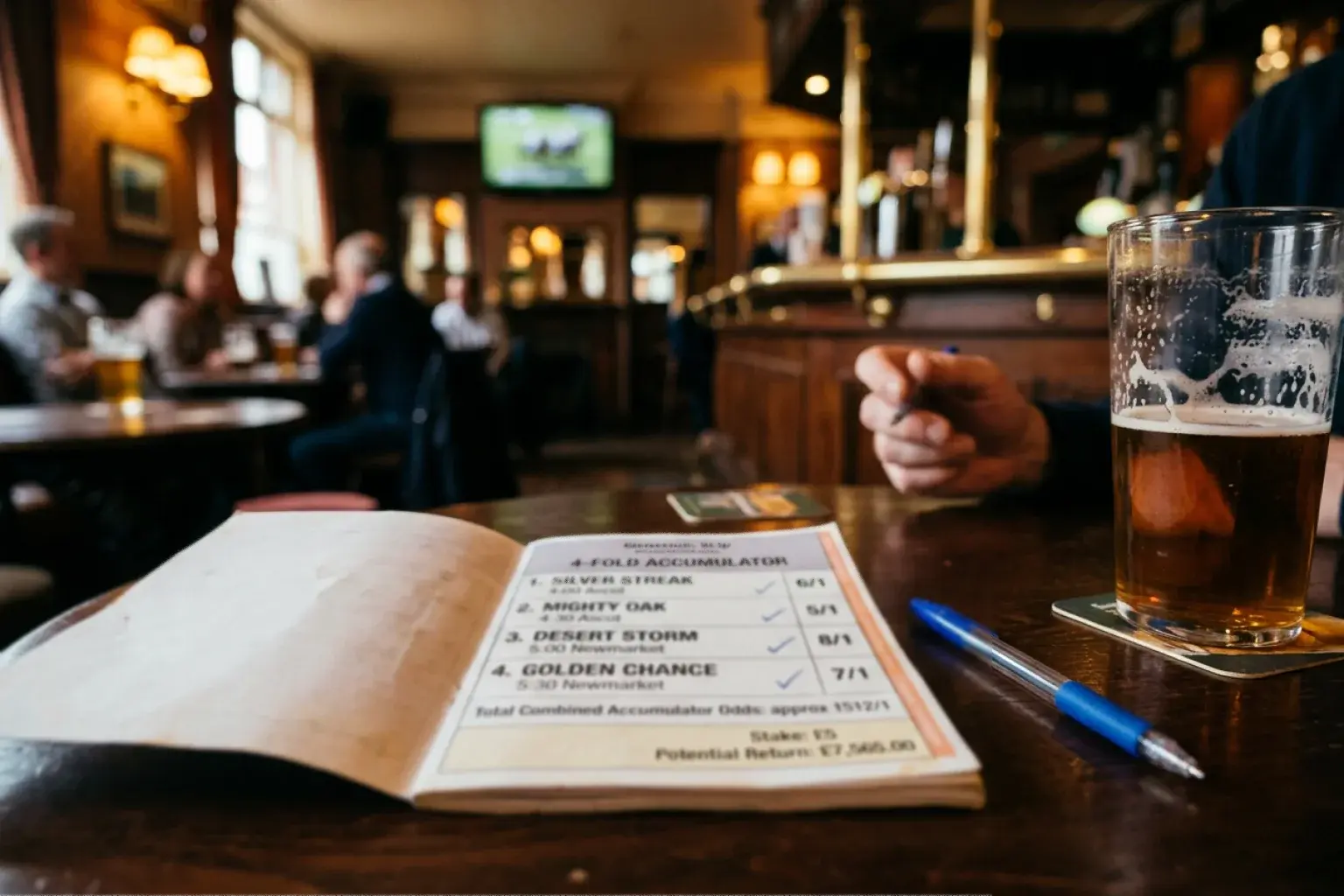
Finally, do not use each-way betting on accumulators without understanding the maths. An each-way accumulator is actually two accumulators — a win acca and a place acca — and the stake doubles for each leg. A four-leg each-way accumulator at £2 each way costs £4, and the place acca often returns less than the total outlay because the place fractions compress the odds at each stage. The full each-way payout only materialises if all four selections win. If they all place but none win, the place acca return is frequently disappointing relative to the total stake invested.