

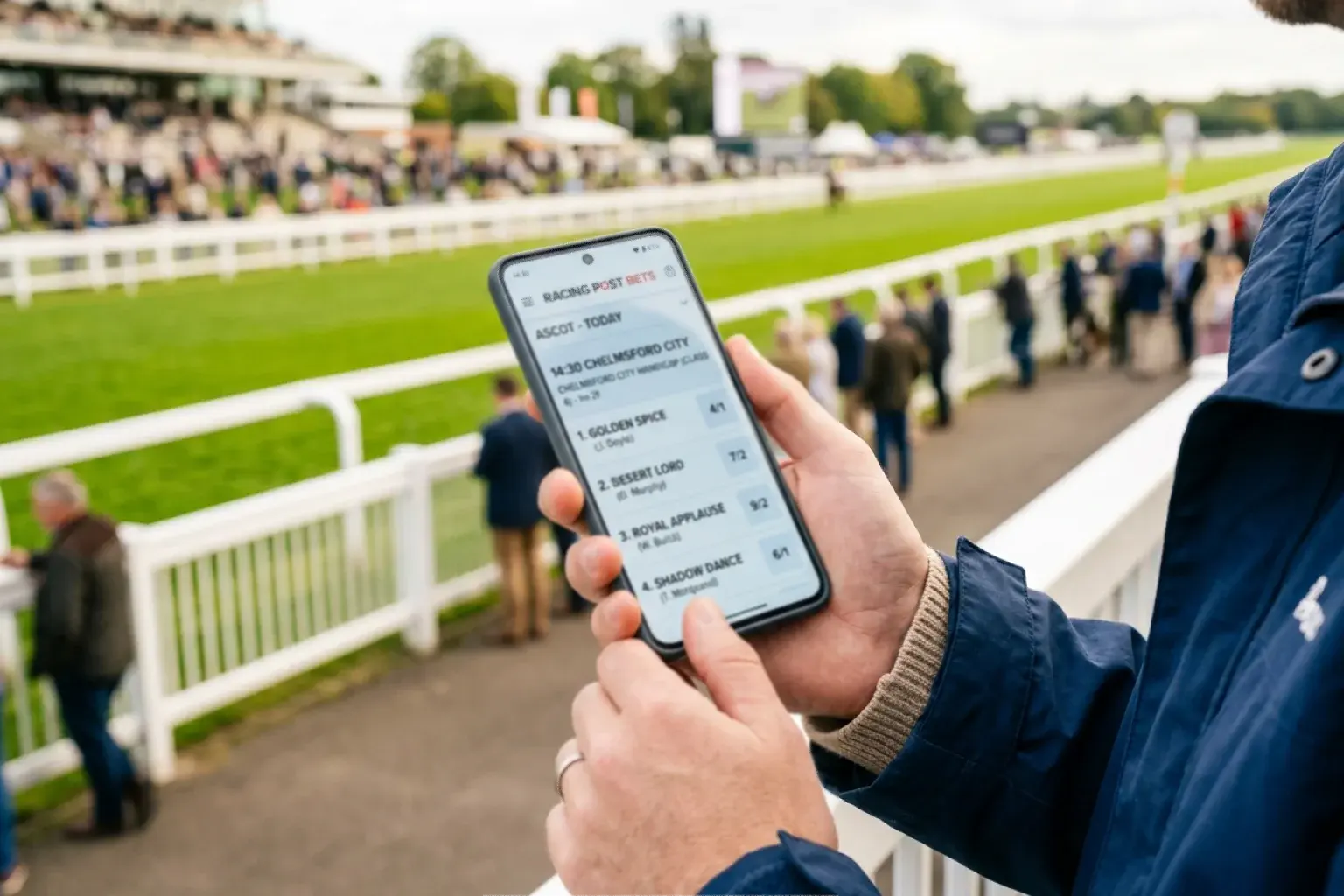
Mobile Betting Apps: Finding Value on Your Phone
At the 2024 Cheltenham Festival, I stood in the Guinness Village watching a race unfold on the big screen while half the crowd around me watched the same race on their phones — and placed bets between races without looking up from those same screens. Over 80% of bets on that meeting were placed through mobile devices, and if anything, the 2026 figure will be higher. The migration from desktop to mobile is not a trend any longer. It is the settled reality of how British punters engage with horse racing.
Across Europe, more than 65% of online betting users rely on mobile apps as their primary platform. In the UK, that figure is almost certainly north of 75% for horse racing specifically, driven by the sport’s live, fast-moving nature. You need to check the market, watch the odds move, place a bet, and potentially cash out — all within the ten-minute window before a race goes off. An app that is slow, cluttered, or unreliable in any of those steps costs you money directly.
The UK supports more than 120 licensed betting operators, and virtually all of them offer a mobile app or mobile-optimised website. But “having an app” and “having a good app” are very different things. What follows is a comparison based on what actually matters for horse racing betting on mobile: speed of odds delivery, streaming reliability, market depth, cash out functionality, and usability under pressure when the next race is three minutes away and you need to place a bet.
The shift to mobile is also reshaping how operators invest. William Hill captured 37.83% of pay-per-click traffic for UK sports betting searches in February 2026, with bet365 at 16.2% — and a growing share of those clicks arrives from mobile devices. Operators know the app is the front door. The ones who treat it as an afterthought lose customers to those who treat it as the product.
A crucial feature for mobile punters is the ability to use horse racing live streaming bookmakers directly from their smartphones.
How We Tested: Speed, Streaming, Markets, and Usability
Over the 2025/26 jump season, I used seven different betting apps simultaneously across two phones — one Android, one iOS — to evaluate the mobile horse racing experience at a granular level. Every app was tested on the same race, at the same time, under the same network conditions. This is not a controlled laboratory test, but it is considerably more rigorous than the typical affiliate review that ranks apps based on who pays the highest commission.
Speed was measured as the time from opening the app to having a loaded racecard with current prices. The best performers loaded within three seconds on a 4G connection. The worst took eight to ten seconds, by which point the odds might have already moved. For in-play betting — where prices update every few seconds — latency is the difference between getting a price and watching it disappear from your screen.
Streaming quality was assessed on resolution, delay relative to live television, and stability over a full afternoon of racing (typically six to seven races over three hours). Some apps delivered smooth, consistent streams throughout. Others buffered intermittently, dropped resolution during peak usage, or introduced a delay of 15 seconds or more compared with terrestrial coverage — a serious problem if you are trying to use the stream for in-play decisions.
Market depth covers how many betting options are available per race. A good racing app should offer win and each-way markets on every UK and Irish runner, plus forecast, tricast, and combination bets. The better apps also provide race-specific specials: top jockey, top trainer, match bets between individual horses, and insurance offers on selected meetings. Navigation matters here — burying the forecast market three taps deep behind the main racecard is functionally the same as not offering it for most users.
Usability under time pressure was the final criterion — and arguably the most important. Horse racing is not like football, where you have 90 minutes to consider an in-play bet. From the point the runners enter the parade ring to the moment the stalls open, you might have ten minutes. From the moment you decide to back a horse to the moment you need the bet confirmed, you might have sixty seconds. An app that requires five taps to reach the bet slip, another two to confirm the stake, and a loading spinner before confirming placement is an app that loses you bets. The best racing apps reduce bet placement to three taps from the racecard: select the horse, enter the stake, confirm. Everything else is friction.
The Best Horse Racing Betting Apps Compared
Rather than ranking apps by a subjective “best” label, I am going to break down what each major category of app does well and where the gaps are. The market divides roughly into three tiers: the established giants with decades of brand history, the mid-tier digital-native operators, and the newer entrants trying to differentiate on technology or user experience.
The established operators — the names you see on racecourse hoardings and ITV Racing sponsorships — generally have the deepest market coverage and the most comprehensive streaming. Their apps carry the full card from every UK and Irish meeting, often supplemented with French, South African, and selected US racing. Flutter Entertainment, the parent company behind multiple major brands, reported group revenue of $15.91 billion in 2025, a 17% increase — and that scale translates directly into app infrastructure. Large operators can afford dedicated streaming servers, faster odds delivery systems, and more responsive customer support within the app.
The mid-tier apps frequently offer a cleaner user experience. Newer codebases mean faster load times, more intuitive navigation, and features like dark mode, quick-bet buttons, and customisable notifications. Where they lag is in streaming coverage — some do not stream every meeting — and in market depth for niche bet types. If you primarily bet win and each-way on UK racing, a mid-tier app may deliver a superior daily experience. If you want forecasts on French racing and live streams of every evening meeting, the established operators are the safer choice.
Newer entrants tend to push innovation: bet builders for racing, AI-powered form analysis within the app, or social features that let you share and discuss selections. Some of these innovations are genuinely useful; others are gimmicks that add complexity without improving returns. The test I apply is simple: does this feature help me place better bets or place bets faster? If the answer is neither, it is noise.
Across all tiers, the number of licensed bookmaker shops in the UK has fallen to 5,825 as of March 2025 — a 36% decline over the past decade. That physical contraction has pushed both operators and punters further into the digital space, making app quality the primary competitive battleground. An operator who loses the app experience race loses customers permanently, because switching costs are almost zero — downloading a competitor’s app takes thirty seconds.
Which Apps Offer Live Racing Streams
Live streaming availability varies more than most punters realise. The broadest coverage comes from apps that license feeds from both SIS (Satellite Information Services) and Racing TV. SIS covers the majority of UK racing fixtures; Racing TV handles the premium meetings at tracks like Cheltenham, Ascot, and Newmarket. An app with both feeds can stream virtually every UK and Irish race. An app with only SIS misses the marquee meetings, which is precisely when streaming matters most.
The standard requirement to unlock streams is a funded account — typically a minimum balance of £1 or a bet placed within the last 24 hours. Some operators require a bet on the specific race you want to watch. This is a minor hurdle for active punters but worth confirming before you settle in to watch an afternoon’s racing on an app where you have not placed a bet.
Stream delay is the critical variable that separates casual viewing from tactical use. If you are watching a race for entertainment, a 10-second delay behind the live action is invisible. If you are watching to inform in-play betting decisions, that same 10-second delay means you are trading on stale information — the market has already moved based on what happened in those ten seconds. The best apps I tested delivered streams with a 3–5 second delay. The worst were 15–20 seconds behind, making them essentially useless for any in-play purpose. For a more thorough breakdown of streaming across operators, I have written a dedicated guide to live streaming bookmakers.
Cash Out Features Across Leading Apps
Cash out — the ability to settle a bet early for a guaranteed return before the race result is known — is now standard across major racing apps. The differences lie in the types of cash out offered and the speed at which offers update. Full cash out closes the bet entirely. Partial cash out lets you take some profit while leaving a portion of the bet running. Auto cash out triggers a settlement when your potential return reaches a threshold you set in advance.
Speed of cash out offer updates matters enormously in racing. During a live race, a horse’s position changes by the second, and the cash out value swings accordingly. An app that updates its offer every two seconds lets you time your exit. An app that updates every ten seconds may show you a figure that is already stale by the time you tap the button — and then reject the cash out because the underlying price has moved. The apps that handle this best show a live countdown or a “price has changed” prompt with the option to accept the updated figure instantly, rather than forcing you to start the process again.
The hidden variable is the margin the bookmaker builds into the cash out offer. Cash out prices are not calculated at fair market value — they include a spread that benefits the operator. On a volatile in-play market, that spread can be substantial. If you plan to use cash out regularly, test it across multiple apps to compare the offers on the same bet. The differences are often surprising.
App Store and Google Play Ratings: What Real Users Say
User ratings on the App Store and Google Play provide a useful sanity check against marketing claims, though they come with caveats. An app with 4.7 stars from 200,000 reviews is telling you something different from one with 4.7 stars from 5,000 reviews. Volume matters. Recency matters more — an app that scored 4.8 two years ago but has slipped to 4.2 in recent months has likely introduced changes or bugs that degraded the experience.
The most informative reviews for horse racing bettors focus on specific pain points: “odds slow to update,” “stream drops during races,” “cash out unavailable on multiples,” “bet placement takes too many taps.” These are actionable complaints that directly affect your betting experience. Generic complaints about lost bets or slow withdrawals tell you more about the reviewer than the app. HBLB Chief Executive Alan Delmonte has emphasised that racing needs to be presented in a way that is attractive to the modern consumer — app quality is where that principle meets reality for the mobile-first punter.
One pattern worth noting: Android ratings tend to run slightly lower than iOS for the same app. This is partly a review-culture difference and partly because Android devices span a wider range of hardware capabilities, meaning the app performs differently across phones. If you are on an older Android device, the app experience may be noticeably worse than on a current-generation iPhone, regardless of the app’s underlying quality.
Reading between the lines of reviews requires filtering for horse racing-specific feedback. Most betting apps serve multiple sports, and the majority of reviews focus on football. A 4.6-star app might be excellent for Premier League betting but mediocre for racing because its racecard navigation is clunky or its each-way bet placement is unintuitive. Searching reviews for terms like “racing,” “horses,” or “streaming” surfaces the relevant experiences. I also pay attention to review dates — an app that received a major update six months ago may have resolved complaints from earlier reviews, or it may have introduced new ones.
Compare mobile performance and exclusive offers at the leading horse racing betting platforms in the UK.
App-Only Features and Mobile Promotions
Several operators now offer features and promotions exclusively through their apps. These range from price boosts available only on mobile (designed to drive app downloads) to app-exclusive bet types, quick-deposit tools using biometric authentication, and push notifications for live odds movements on horses you have shortlisted.
Price boosts are the most common app-only promotion. A horse showing 5/1 on the website might be boosted to 6/1 or 7/1 on the app. These boosts represent genuine additional value — they are typically limited to one per customer and capped at a modest stake, but if you are already backing the horse, the uplift is free. The tactical approach is to check the app first for any boosted prices before placing through the desktop site.
Push notifications for market movers are underrated. Significant money entering the market for a horse — a “steamer” — is often visible as a sharp price contraction. An app that alerts you when a horse on your watchlist shortens by more than two points gives you time to act, either backing the horse before the price tightens further or adjusting your plans for the race. Not all apps offer this feature, and those that do vary in how quickly the notifications fire relative to the actual price movement.
Biometric deposit tools (Touch ID, Face ID) remove the friction of entering card details or passwords when topping up mid-session. It is a small quality-of-life improvement, but when you are trying to deposit and bet in the final minutes before a race, every saved second counts.
Customisable home screens are another feature worth evaluating. Some apps let you pin your preferred horse racing section to the main screen, so you bypass the default football-heavy landing page. Others allow you to create a personal “today’s racing” view that shows only the meetings and races you are interested in, filtered by course, time, or race type. Over a season of daily use, these small navigational savings accumulate into a materially better experience. The apps that understand racing punters as a distinct user group — rather than a subcategory of football bettors — consistently deliver the most refined mobile experience.
Load Times, Stability, and Battery Impact
In my testing, the fastest apps loaded a full racecard in under three seconds on 4G and under two seconds on 5G. The slowest took eight seconds or more — an eternity when the market is moving. Stability across an afternoon session (three to four hours of continuous use, with streaming and bet placement) was uniformly good on iOS across all tested apps. Android performance was more variable, with two apps experiencing crashes during high-traffic periods on Grand National day.
Battery consumption is the sleeper issue. Live streaming is the biggest drain — an afternoon of continuous streaming can consume 25–40% of a phone’s battery depending on the device and screen brightness. If you plan to use your phone for both streaming and betting at the racecourse or away from a charger, dimming the screen and closing background apps extends your session significantly. Some apps offer an audio-only mode for races, which cuts battery usage by roughly half while still letting you follow the action.
Data usage matters for punters on limited mobile plans. A three-hour streaming session can consume 1.5 to 3 GB of data depending on stream quality. At the racecourse, where thousands of devices compete for cell tower capacity, streaming can become unreliable regardless of your app or plan. Wi-Fi availability at UK racecourses is improving but remains patchy outside the main grandstands.
The overall picture is that mobile betting apps have matured significantly over the past three years. The worst apps are now acceptable; the best are genuinely excellent. The gap between them narrows each season as competitive pressure forces improvements. For the horse racing punter in 2026, the most important decision is not which app to choose — it is to use the app actively and deliberately, taking advantage of features like quick-bet, streaming, and price alerts rather than treating it as a smaller version of the desktop site.