

Betting Strategies: Leveraging Data for Consistent Value
Three years ago, a friend showed me his betting spreadsheet. Twelve months of meticulous records, every selection logged with reasoning and confidence level. His strike rate was a respectable 22%. His staking was aggressive but not reckless. And he was down £3,400. The problem was not his ability to pick horses — it was that the odds he accepted never reflected the true probability of his selections winning. He was betting on the right horses at the wrong prices, and no amount of form analysis can fix that.
The average betting turnover per race in British racing has fallen by 8% in the 2024/25 season compared with the previous year, by 15% compared with 2022/23, and by 19% compared with 2021/22. Those declines tell a story. Casual punters are leaving the market — driven partly by regulatory friction, partly by competing entertainment options — and the punters who remain are, on average, more informed and more price-sensitive. The market is getting sharper. Betting at random or on gut feel worked tolerably well when the pools were soft and the casual money inflated the prices. It does not work now.
Total wagering volume on British racing was roughly £10 billion in 2022, dropping to £9.1 billion in 2023 and £8.4 billion in 2024 — a real-terms fall of £3 billion once inflation is factored in. The remaining pool is contested by professional punters, syndicates, and exchanges with sophisticated pricing models. If you are going to survive in that environment, you need a strategy that accounts for value, manages risk, and reads form through the lens of data rather than sentiment. That is what this guide delivers.
To ensure long-term profitability, combining value identification with strict bankroll management for horse racing is absolutely essential.
Value Betting Explained: Finding Odds the Market Has Wrong
I once backed a horse at Haydock at 12/1 that I estimated had a genuine 15% chance of winning. In fractional terms, a 15% chance equates to roughly 11/2. The market was offering 12/1, which implies a probability of just over 7%. The market thought this horse had half the chance I gave it. That gap — between what you believe the probability to be and what the odds suggest — is value. Finding it consistently is the single most important skill in profitable horse racing betting.
Value betting does not mean backing longshots. It means identifying situations where the odds offered exceed the actual probability of an outcome occurring. A 2/1 favourite can be a value bet if you calculate its real chance of winning at 45% or above, because 2/1 implies only 33%. Conversely, a 20/1 outsider is terrible value if its true probability of winning is just 2%, because 20/1 implies a 4.8% chance — you are getting roughly double the implied probability but the horse barely has a prayer.
The practical method I use involves three steps. First, form your own probability estimate for each runner in a race, based on form, conditions, jockey, trainer, and any other relevant factors. Second, convert the bookmaker’s odds into implied probabilities. Third, compare. Where your probability exceeds the implied probability of the odds, you have a value bet. Where it falls short, you pass.
Converting odds to implied probability is simple arithmetic. For fractional odds of A/B, the implied probability is B divided by (A + B), then multiplied by 100. So 5/1 equals 1 divided by 6, which is 16.7%. For decimal odds, divide 1 by the decimal: 6.0 becomes 16.7%. The bookmaker builds an overround into their prices — the sum of all implied probabilities in a race typically exceeds 100% by 10–20 points — so you need to be finding genuine value to overcome that built-in margin. The average turnover per race on Core Fixtures dropped 14.4% year on year in Q1 2025, meaning the remaining market is tighter and sharper. Finding value requires more effort than it did five years ago, but the effort pays off precisely because fewer casual punters are muddying the prices.
How to Read and Compare Horse Racing Odds
Odds come in three formats in the UK market: fractional, decimal, and American. Fractional is the traditional standard — 5/1, 7/2, 11/4 — and remains the default on most UK betting sites and at the racecourse. Decimal odds express the total return per unit staked: 6.00 means a £1 bet returns £6 (£5 profit plus £1 stake). American odds are largely irrelevant to UK racing but appear on some international platforms.
Reading odds effectively means understanding what they imply about the market’s view of a race. The favourite — the horse with the shortest odds — is the runner the market collectively considers most likely to win. But “most likely” is not the same as “likely to win.” A 2/1 favourite wins roughly one race in three. A 5/2 favourite wins roughly two races in seven. If you are backing favourites expecting them to win more often than that, your expectations are miscalibrated, and your staking will suffer.
Comparing odds across bookmakers is where practical edge lives. Price differences of a point or two are common on every race. A horse showing 7/1 with one bookmaker might be 8/1 or 15/2 with another. Over a single bet, the difference is modest. Over 500 bets in a year, it compounds significantly — the equivalent of several additional winners at short prices. I check at least three operators before placing every bet, and the habit takes under thirty seconds per race. That time investment yields a measurable improvement in annual returns.
Bankroll Management: Staking Plans That Protect Your Funds
A punter I respect once told me that bankroll management is the only betting strategy that works even when your selections are wrong. He was being slightly flippant, but the core point is sound: proper staking cannot turn losing selections into winners, but it can prevent a bad run from destroying your ability to bet at all. And in horse racing — where even the best professional tipsters operate at strike rates of 15–25% — bad runs are not a possibility but a certainty.
Your bankroll is the total amount of money you have allocated specifically for betting. It is not your savings, not your rent, not money you need for anything else. It is a separate, dedicated fund. The first rule is to set it at a level you can afford to lose entirely without financial hardship. The second rule is to never add to it impulsively. If the bankroll runs out, you stop. Richard Wayman, the BHA’s Director of Racing, has spoken bluntly about the impact of affordability checks on the industry and the extent to which they have driven punters toward unlicensed operators or out of the market entirely. Whatever your view on affordability regulation, the underlying principle — that betting should be sustainable and proportionate to your means — is not one any serious punter disputes.
Once the bankroll is set, staking discipline determines how long it lasts and how effectively it grows. The two most common approaches are level staking and percentage staking. Level staking means betting the same fixed amount on every selection — say, £10 per bet on a £1,000 bankroll (1% of the total). Percentage staking means betting a fixed percentage of your current bankroll, so the stake adjusts as your balance rises or falls. Both have merits and drawbacks, and the right choice depends on your risk tolerance and betting volume.
Participation in horse racing betting sat at 7% during April to July 2025 but dropped to 4% in the July to October window, reflecting the seasonal nature of the sport and the way punters’ engagement fluctuates. Bankroll management needs to account for these cycles. A punter who bets heavily during the jump season and lightly during the summer flat needs a staking plan that preserves capital during the quieter months rather than chasing turnover.
Level Stakes vs Percentage Staking: Which Performs Better
Level staking is the simplest approach and the one I recommend to anyone starting out. You decide on a unit size — 1% to 2% of your bankroll is a sensible starting point — and every bet is placed at that amount regardless of confidence, odds, or race type. The advantage is psychological: you remove the temptation to increase stakes on “certainties” or “strong fancies,” which is where most punters blow up their bankrolls.
The downside of level staking is that it does not respond to changing circumstances. If your bankroll doubles, your stakes remain the same, and you are effectively reducing your exposure as a percentage. If your bankroll halves, your stakes represent a larger and riskier proportion. Over a very long series of bets, this rigidity can limit growth on the upside and accelerate losses on the downside.
Percentage staking addresses this by scaling with the bankroll. A 2% rule means betting £20 on a £1,000 bankroll, £24 on a £1,200 bankroll, and £16 on an £800 bankroll. The stakes grow when you are winning and shrink when you are losing, which is mathematically closer to the Kelly Criterion — the theoretically optimal staking method for known-edge situations. The drawback is that it requires recalculating before every bet and demands rigorous record-keeping.
In practice, I use a hybrid. Level stakes for the majority of my bets, with a modest uplift — never more than 1.5x my standard unit — on selections where I believe the value is exceptionally strong and the odds are 5/1 or above. This limits the damage from overconfidence while allowing slightly larger exposure on the bets where the expected value is highest. Whatever system you choose, the non-negotiable rule is this: never stake more than 5% of your bankroll on a single bet. That ceiling applies to accumulators, doubles, and any other multiple. One bad result should not cost you a twentieth of your funds.
Form Analysis: Reading the Racecard for Betting Edges
The racecard is where horse racing reveals itself to anyone willing to look closely enough. I remember the first time the numbers on a racecard made sense to me — not as abstract sequences, but as a compressed story of a horse’s career, fitness, and likely performance. It took about six months of daily study to reach that point, and I have been refining my reading ever since.
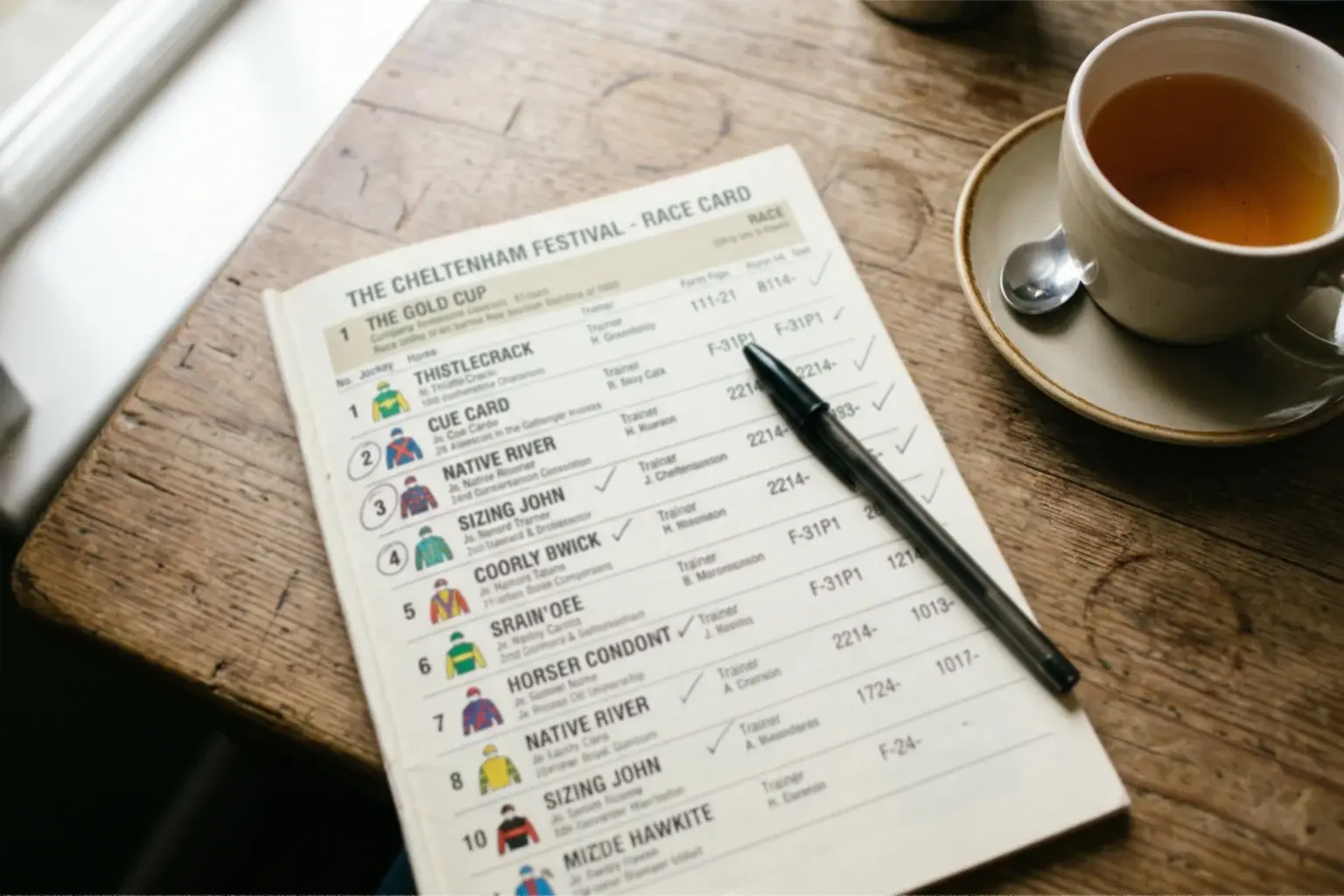
A standard UK racecard contains the horse’s name, age, weight carried, draw position (in flat races), trainer, jockey, form figures, official rating, and days since last run. Each element tells you something. The form figures — a sequence of numbers showing finishing positions in recent races, read right to left with the most recent result first — are the starting point. A sequence like 2131 tells you the horse finished first last time, third the time before, first before that, and second before that. Consistency is visible at a glance.
But form figures alone are misleading. A horse that finished third in a Grade 1 at Cheltenham is demonstrating far superior ability to one that finished first in a Class 5 seller at Wolverhampton. Context is everything: the class of race, the quality of opposition, the distance, the ground conditions, and the course all shape the meaning of a result. Reading form properly means evaluating each run within its context, not treating all finishing positions as equivalent.
The going — ground conditions ranging from firm to heavy — is perhaps the single most important contextual factor. A horse with a form string of 11121 all achieved on good to firm ground becomes an entirely different proposition on soft ground. Some horses act on any surface; most have clear preferences. Cross-referencing form figures with the going on each occasion is a non-negotiable step in any serious form analysis, and I cover ground conditions in depth in a separate guide to the going.
Distance, weight, and fitness complete the picture. Horses that have been running consistently — say, a race every two to three weeks — tend to be fitter and more race-sharp than those returning from layoffs. But freshness has value too, particularly with well-handicapped runners whose trainer has been waiting for the right conditions. The racecard gives you the days since last run; your job is to decide whether that interval suggests peak fitness, staleness, or calculated freshness.
For the most reliable data and bookmaker reviews, always consult the best UK horse racing betting sites before placing your wagers.
Trainer and Jockey Statistics as a Selection Filter
Trainers and jockeys are not equal, and the statistics prove it. Strike rates — the percentage of runners that win — vary enormously. A top flat trainer might operate at a 20–25% strike rate, meaning roughly one in four or five of their runners wins. A mid-table jumps trainer might be at 8–12%. These baselines matter because they frame your probability estimates. If a trainer runs a horse in a Class 3 handicap and their strike rate in that category is 6%, you need a strong reason to rate the horse’s chance above that baseline.
Jockey bookings are a signal in themselves. When a top jockey is booked for a horse that has previously been ridden by a less prominent rider, it often indicates the connections believe the horse has an improved chance. This is not infallible — jockeys have retainers and scheduling constraints — but persistent jockey upgrades for a specific trainer in a specific race category are worth noting.
Course-specific statistics add another layer. Some trainers excel at particular tracks. A jumps trainer based in Lambourn may have a 25% strike rate at Newbury (just down the road, familiar conditions) but only 8% at Ayr (long journey, different ground). These patterns are not random — they reflect training methods, travel logistics, and the fit between a stable’s horses and a course’s characteristics. Any serious form analysis incorporates trainer-at-course data as a filtering mechanism, discounting selections where the trainer’s track record at the venue is poor and upgrading those where it is strong.
Seasonal Betting Patterns: When Markets Are Softest
Not every month of the racing year is equal, and the punter who treats them the same leaves money on the table. The jump season opens in earnest in October and builds through the winter toward Cheltenham in March and Aintree in April. During this arc, the market is deep, the media coverage is intense, and the prices are generally sharp — meaning the odds closely reflect true probabilities and value is harder to find.
The shoulder months tell a different story. Early-season jump racing in October and November features horses returning from summer breaks, trainers testing new recruits, and a betting market that has not yet settled into its rhythm. Prices are wider, form is less exposed, and the opportunity to find value is higher. Similarly, the period after Cheltenham and Aintree — late April through May — sees a winding down of the jump season and a build-up to the flat, with smaller fields and less public interest driving softer markets.
The flat season has its own cycles. The Guineas in May and the Derby meeting in June attract enormous attention, and prices are sharp. But the summer months — July and August — feature vast numbers of handicaps and lower-grade races at multiple venues simultaneously, and the market cannot price all of them with equal efficiency. Midweek meetings at courses like Catterick, Beverley, and Carlisle often present softer odds than the high-profile Saturday cards at Ascot or York. Racecourse attendance reached 5.031 million in 2025 — the first time above five million since 2019 — confirming that the sport’s in-person audience is recovering, but the day-to-day betting market remains thinner at the lower levels.
The tactical conclusion is straightforward: concentrate your highest-conviction bets during the shoulder months and midweek fixtures, where prices are most likely to be inefficient. Maintain discipline and smaller stakes during the peak periods — Cheltenham, Royal Ascot, Glorious Goodwood — where the market is sharpest and the edge is slimmest. This counter-cyclical approach is not glamorous, but it is how professionals sustain returns across the full racing year.